
Volume of Planter Box: Modeling with Functions, Derivatives, and Linear Regressi
Loading the math board and drawing, please wait…
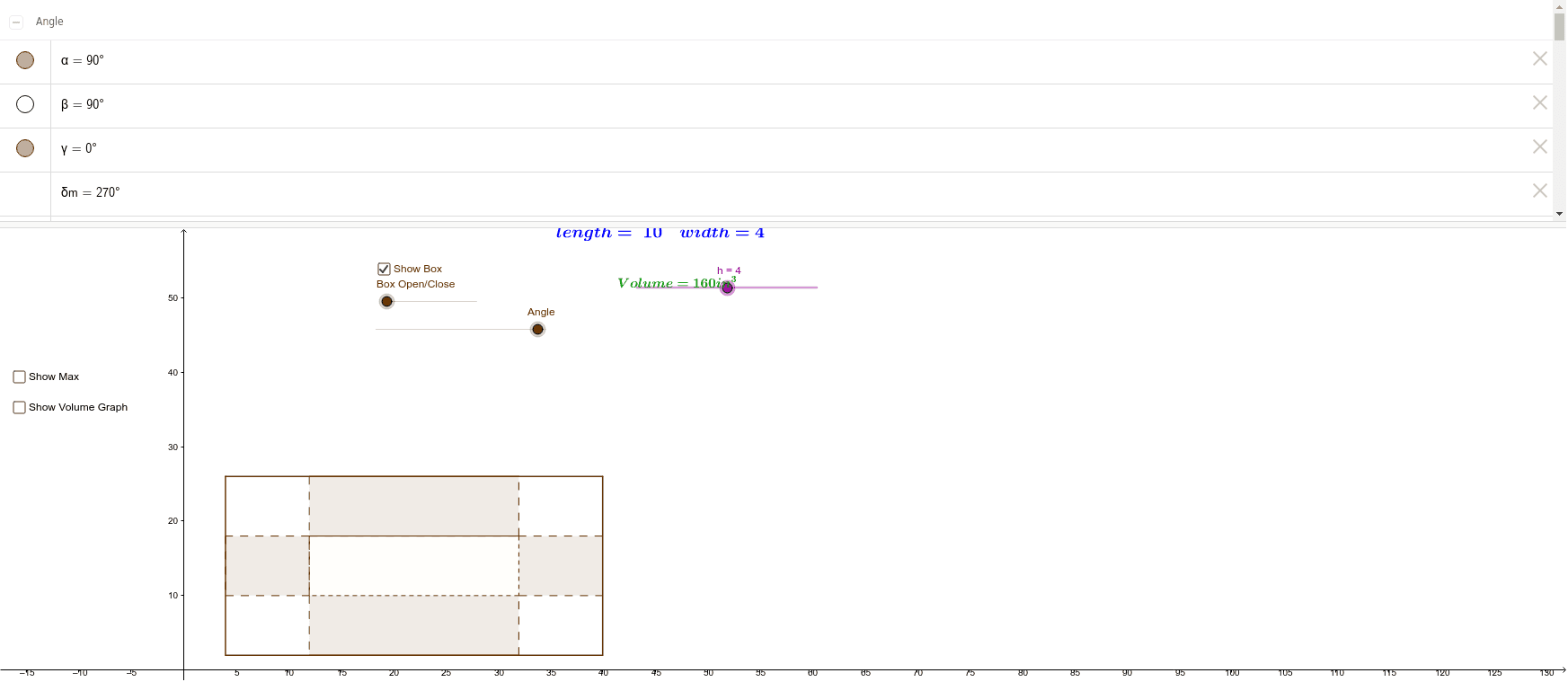
This GeoGebra example demonstrates how to model the volume of a planter box using functions, derivatives, and linear regression. It visualizes the relationship between box dimensions and volume, and explores optimization through derivative-based extremum finding. Core mathematical concepts include volume calculation, function modeling, derivative for optimization, linear regression for data fitting, and scatter plot analysis. The construction uses commands such as Function, Segment, Rotate, Line, Intersect, Angle, Polygon, Derivative, Root, and Min, along with sliders to dynamically adjust parameters. It is suitable for high school or early college students learning applied calculus, data modeling, and optimization in real-world contexts, and can serve as a cross-disciplinary project in engineering design.
GeoGebra Commands & Parameters
Function(((x * (length_1 - (2 * x))) * (width - (2 * x))), 0, Vright) → VSegment(B, C) → bRotate(B, α, A) → B'Line(B', A) → sLine(Ax, s) → s1Segment(A, B) → aLine(C, a) → rIntersect(s, r) → DLine(Dy, r) → r1Intersect(r1, b) → CySegment(Dy, Cy) → l_3Segment(C, D) → cIntersect(s1, c) → DxSegment(Ax, Dx) → d1Intersect(d1, l_3) → D1Line(B, s) → qLine(Bx, q) → q1Intersect(q1, c) → CxSegment(Bx, Cx) → b1Intersect(b1, l_3) → C1Line(A, B) → pLine(Ay, p) → p1Intersect(p1, b) → BySegment(Ay, By) → a1Intersect(d1, a1) → A1Intersect(b1, a1) → B1Angle(B, A, B') → βSegment(D, A) → dPolygon(A1, A2a, B2a, B1) → poly1, e, f, g, h_1Polygon(B1, B2b, C2b, C1) → poly2, i, j, k, l_2Polygon(C1, C2c, D2c, D1) → poly3, c_1, d_1, e_1, f_1Polygon(D1, D2d, A2d, A1) → poly4, m, n, a_1, b_1Derivative(V) → VderRoot(Vder) → tMax_1, tMax_2Min(x(tMax_1), x(tMax_2)) → tMaxSegment(tMax_1, P) → g_1Intersect(l_3, d1) → EIntersect(l_3, b1) → FIntersect(b1, a1) → GIntersect(d1, a1) → HPolygon(E, F, G, H) → poly5, e_2, f_2, g_2, h_2Intersect(l_3, d1) → IIntersect(l_3, b1) → JSegment(I, J) → len1Intersect(d1, a1) → KSegment(I, K) → j_1Intersect(l_3, d1) → NIntersect(l_3, b1) → OSegment(N, O) → m_1Intersect(k, l_2) → QIntersect(c, c_1) → RIntersect(b, c) → T