
Volume of Planter Box by Danielle
Loading the math board and drawing, please wait…
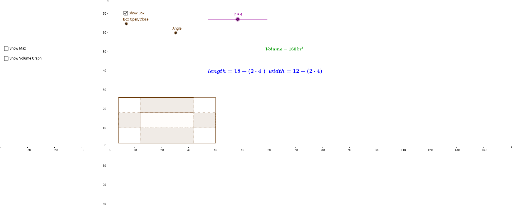
This example demonstrates how to calculate the volume of a planter box using GeoGebra. It involves core mathematical concepts such as volume calculation, functions, geometric transformations, derivatives, and optimization. Key GeoGebra commands and objects used include Function, Segment, Rotate, Line, Intersect, Angle, Polygon, Derivative, Root, Min, and Point for constructing the model and computing the volume. Suitable for high school mathematics teaching and geometric modeling practice.
GeoGebra Commands & Parameters
Function(((x * (length_1 - (2 * x))) * (width - (2 * x))), 0, Vright) → VSegment(B, C) → bRotate(B, α, A) → B'Line(B', A) → sLine(Ax, s) → s1Segment(A, B) → aLine(C, a) → rIntersect(s, r) → DLine(Dy, r) → r1Intersect(r1, b) → CySegment(Dy, Cy) → l_3Segment(C, D) → cIntersect(s1, c) → DxSegment(Ax, Dx) → d1Intersect(d1, l_3) → D1Line(B, s) → qLine(Bx, q) → q1Intersect(q1, c) → CxSegment(Bx, Cx) → b1Intersect(b1, l_3) → C1Line(A, B) → pLine(Ay, p) → p1Intersect(p1, b) → BySegment(Ay, By) → a1Intersect(d1, a1) → A1Intersect(b1, a1) → B1Angle(B, A, B') → βSegment(D, A) → dPolygon(A1, A2a, B2a, B1) → poly1, e, f, g, h_1Polygon(B1, B2b, C2b, C1) → poly2, i, j, k, l_2Polygon(C1, C2c, D2c, D1) → poly3, c_1, d_1, e_1, f_1Polygon(D1, D2d, A2d, A1) → poly4, m, n, a_1, b_1Derivative(V) → VderRoot(Vder) → tMax_1, tMax_2Min(x(tMax_1), x(tMax_2)) → tMaxSegment(tMax_1, P) → g_1Intersect(l_3, d1) → EIntersect(l_3, b1) → FIntersect(b1, a1) → GIntersect(d1, a1) → HPolygon(E, F, G, H) → poly5, e_2, f_2, g_2, h_2Intersect(l_3, d1) → IIntersect(l_3, b1) → JSegment(I, J) → len1Intersect(d1, a1) → KSegment(I, K) → j_1Intersect(b1, a1) → LSegment(K, L) → k_1Segment(L, J) → width1Intersect(l_3, d1) → NIntersect(l_3, b1) → OSegment(N, O) → m_1Intersect(k, l_2) → QIntersect(c, c_1) → RPoint(b) → SIntersect(b, c) → TPolygon(R, Q, S, T) → poly6, r_1, q_1, s_1, t_1
AI Drawing Prompt Reference
Please draw a geometric model for calculating the volume of a planter box. This model includes key objects such as functions, segments, rotations, lines, intersections, angles, polygons, derivatives, and roots. First, define a function representing the volume, then construct geometric shapes to calculate this volume. Specific steps include drawing segments, rotating points, finding intersections, building polygons, etc. The ultimate goal is to find the maximum volume using derivatives and optimization methods.
The prompt above was compiled from the original drawing commands and is for reference only.