
Volume of a Rectangular Prism Using Cubes
Loading the math board and drawing, please wait…
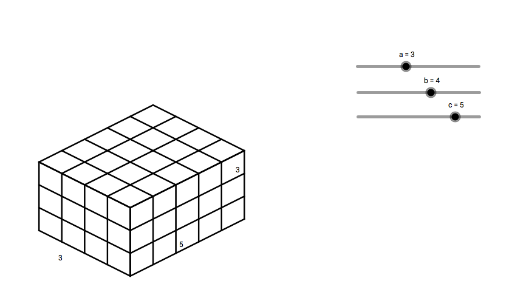
This example visually demonstrates how to calculate the volume of a rectangular prism by filling it with smaller cubes, providing an intuitive understanding of the volume concept. Key math concepts include the volume formula for rectangular prisms, 3D spatial geometry, and unit volume. The construction utilizes GeoGebra's Sequence command to generate a series of cubes, along with parameters a, b, c and multiple list objects (list1-list6) for data management, complemented by text objects (text1-text3) for explanations. It is suitable for middle school students and above learning 3D geometry volume calculations, as well as for teaching demonstrations on volume unit conversions.
GeoGebra Commands & Parameters
Sequence(Segment[(n, a - n / 2), (n, ((-n)) / 2)], n, 0, b) → list1Sequence(Segment[(n + b, ((-b)) / 2 + n / 2), (n + b, ((-b)) / 2 + n / 2 + a)], n, 0, c) → list2Sequence(Segment[(0, a - n), (b, ((-b)) / 2 - n + a)], n, 0, a) → list3Sequence(Segment[(b, ((-b)) / 2 + n), (b + c, ((-b)) / 2 + n + c / 2)], n, 0, a) → list4Sequence(Segment[(n, ((-n)) / 2 + a), (n + c, c / 2 - n / 2 + a)], n, 0, b) → list5Sequence(Segment[(n, a + n / 2), (n + b, a + n / 2 - b / 2)], n, 0, c) → list6