
Volume of a Pyramid by the Cube
Loading the math board and drawing, please wait…
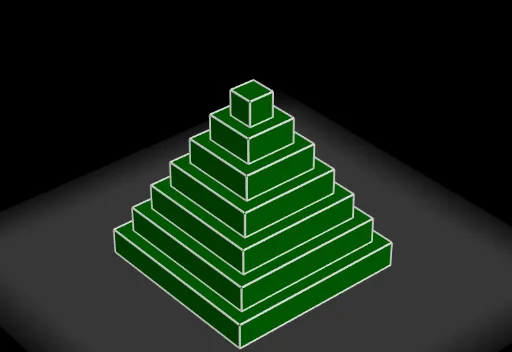
① This GeoGebra example demonstrates the volume of a pyramid by comparing it with a cube, showing that the pyramid's volume is one-third of the cube with the same base and height. ② Core mathematical concepts include the pyramid volume formula, the idea of integration (approximating the pyramid as a stack of infinitesimal slices), ratios, and solid geometry. ③ Construction highlights: using GeoGebra commands such as Sequence and Sum to generate and sum layers, Point and Midpoint to define key points, a slider to control the number of layers, and text objects (texte1-4) and images (image1-5) to enhance the visual explanation. ④ Suitable for high school or early college students to understand the derivation of the volume formula, as an intuitive introduction to definite integrals in calculus, or as a dynamic teaching tool in solid geometry.
GeoGebra Commands & Parameters
Sequence(Prism[Polygon[((5 * (n - k) / n), (5 * (n - k) / n), (10 * k / n)), ((-5 * (n - k) / n), (5 * (n - k) / n), (10 * k / n)), ((-5 * (n - k) / n), (-5 * (n - k) / n), (10 * k / n)), ((5 * (n - k) / n), (-5 * (n - k) / n), (10 * k / n))], 10 / n], k, 0, n - 1) → liste1Sum(liste1) → aSequence(Prism[Polygon[((5 * (n - k) / n), (5 * (n - k) / n), (10 * k / n)), ((-5 * (n - k) / n), (5 * (n - k) / n), (10 * k / n)), ((-5 * (n - k) / n), (-5 * (n - k) / n), (10 * k / n)), ((5 * (n - k) / n), (-5 * (n - k) / n), (10 * k / n))], 10 / n], k, 0, n - 1) → liste2Point(liste1) → APoint(liste2) → BMidpoint(B, A) → C
AI Drawing Prompt Reference
Draw a cube and a pyramid with equal base area and height, showing the pyramid's volume is one-third of the cube's volume by approximating the pyramid as a stack of tiny triangular prisms cut from the cube, use a slider to control the number of layers, and include text and images to explain the volume formula and integral concept.
The prompt above was compiled from the original drawing commands and is for reference only.