
Volume of a Pyramid by chris cambré
Loading the math board and drawing, please wait…
In collections
Volume of a pyramid
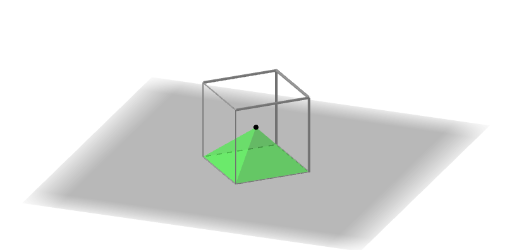
This example demonstrates the calculation of a pyramid's volume. Key mathematical concepts include the volume formula for a pyramid and geometric construction. Using GeoGebra commands such as Point, Cube, Intersect, etc., a pyramid can be constructed and its volume calculated. Suitable for middle school and above students learning geometry and volume calculation.
GeoGebra Commands & Parameters
Point(xAxis) → APoint(yAxis) → BPoint(Circle[B, Distance[A, B], Segment[A, B]]) → CCube(A, B, C) → a, D, faceCDHG, faceEFGH, edgeAD, edgeAB, edgeBC, edgeCD, edgeAE, edgeDH, edgeEH, edgeEF, E, edgeBF, edgeFG, edgeCG, edgeGH, F, G, H, faceABCD, faceADHE, faceABFE, faceBCGFCircle(edgeAB, F) → cPoint(c) → NIntersect(xOyPlane, c) → L, MCircumcircleArc(F, N, M) → hMidpoint(D, F) → IPyramid(faceABCD, I) → b, faceADI, faceABI_1, faceBCI, faceCDI, edgeDI, edgeAI_1, edgeBI_1, edgeCIPoint(h) → JAngle(F, B, J) → αPyramid(faceABFE, I) → d, faceABI, faceAEI, faceEFI, faceBFI, edgeBI, edgeAI, edgeEI, edgeFIRotate(d, α, edgeAB) → d'Rotate(d', 90°, zAxis) → d''Rotate(d'', 90°, zAxis) → d'''Rotate(d''', 90°, zAxis) → eLine(B, J) → fMidpoint(B, J) → KOrthogonalPlane(K, f) → gMirror(b, g) → b'
AI Drawing Prompt Reference
Draw a cube and a line segment from the midpoint of one of its base edges perpendicular to the base, with the length equal to half the cube's edge length. Construct a pyramid with this segment as the height and the base as the cube's face. Copy this pyramid three times, rotating each copy around the base edge by 30, 60, and 90 degrees. Finally, draw a circle at the pyramid's apex, project it down to the base to get two points, and connect these points to the apex to form four smaller triangular pyramids.
The prompt above was compiled from the original drawing commands and is for reference only.