
Volume Calculation of a Cube
Loading the math board and drawing, please wait…
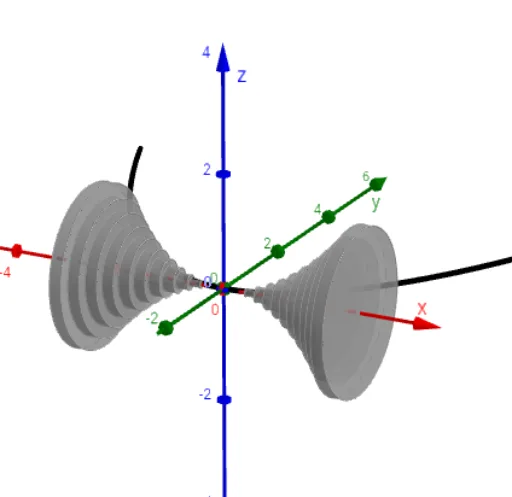
This example demonstrates how to calculate the volume of a cube using step functions. Key mathematical concepts include functions, step functions, and integrals. Using GeoGebra commands such as Sequence, Sum, RectangleSum, and Integral, the process of volume calculation is visually illustrated. Suitable for high school mathematics education and learning.
GeoGebra Commands & Parameters
Sequence(Cylinder[(ax + (deltax * k / n), 0), (ax + (deltax * (k + 1) / n), 0), f((ax + (deltax * k / n) + ax + (deltax * (k + 1) / n)) / 2)], k, 0, n - 1) → list1Sum(list1) → appsumRectangleSum(f, ax, bx, n, 0.5) → aIntegral((π * f(x)^(2)), ax, bx) → actualsumTextfield(f) → InputBox1Textfield(ax) → InputBox2Textfield(bx) → InputBox3Surface(t, (f(t) * cos(u)), (f(t) * sin(u)), t, ax, bx, u, 0, rot) → bIf(f(ax) ≟ f(ax), 1, 0) → condaIf(f(bx) ≟ f(bx), 1, 0) → condb
AI Drawing Prompt Reference
Draw the volume calculation process of a cube using step functions to represent each part of the cube. First, define the edge length of the cube, then use step functions to represent each part, calculate the volume sum of these parts, and finally use integration to get the exact volume.
The prompt above was compiled from the original drawing commands and is for reference only.