
Volume by Washers Example
Loading the math board and drawing, please wait…
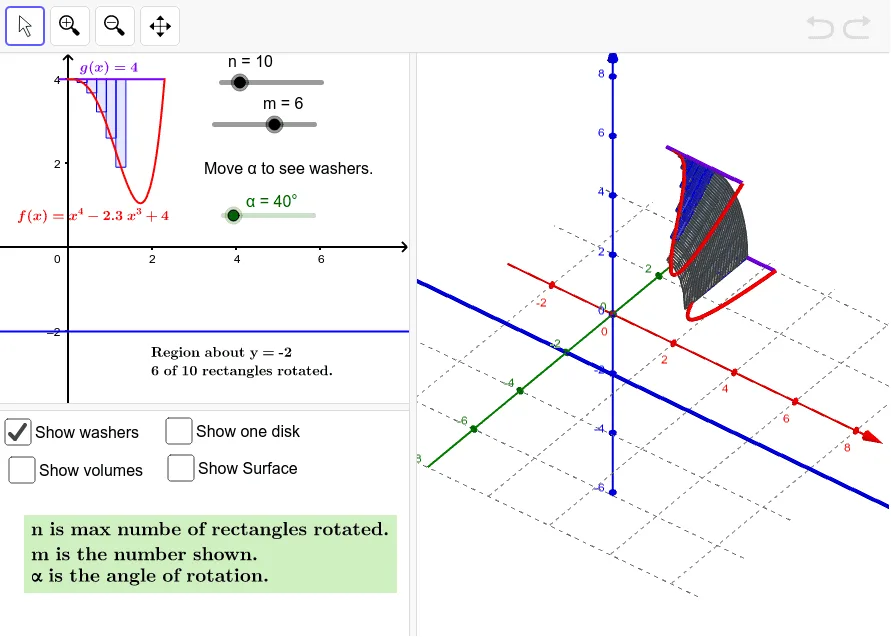
This example demonstrates how to calculate the volume of a solid of revolution using the washer method. It involves core calculus concepts like integration, washer method, and rotating function graphs. Constructed using GeoGebra commands such as Sequence, Polygon, Rotate, Integral, Surface, and RectangleSum, it is suitable for high school and above students learning about volume calculations in calculus.
GeoGebra Commands & Parameters
Sequence(Polygon[((k * h), f(((k + p) * h))), (((k + 1) * h), f(((k + p) * h))), (((k + 1) * h), g(((k + p) * h))), ((k * h), g(((k + p) * h)))], k, 0, m - 1) → RectanglesPolygon(((DK * h), f(((DK + p) * h))), (((DK + 1) * h), f(((DK + p) * h))), (((DK + 1) * h), g(((DK + p) * h))), ((DK * h), g(((DK + p) * h)))) → Rectangle1, b, c, d, eRotate(Rectangle1, (-α), a) → Rectangle1'Integral((π * ((2 + g(x))^(2) - (2 + f(x))^(2))), 0, 2.3) → VolIntegRotate(Rectangles, (-α), a) → Rectangles'Rotate(g_1, (-α), a) → iRotate(f_1, (-α), a) → jSurface(u, -2 + ((2 + f(((DK + p) * h))) * cos(β)), ((2 + f(((DK + p) * h))) * sin(β)), u, (DK * h), ((DK + 1) * h), β, 0, α) → Inner1Surface(u, -2 + ((2 + g(((DK + p) * h))) * cos(β)), ((2 + g(((DK + p) * h))) * sin(β)), u, (DK * h), ((DK + 1) * h), β, 0, α) → Outer1Surface((DK * h), -2 + ((u + 2) * cos(β)), ((u + 2) * sin(β)), u, f(((DK + p) * h)), g(((DK + p) * h)), β, 0, α) → SideLeft1Surface(((DK + 1) * h), -2 + ((u + 2) * cos(β)), ((u + 2) * sin(β)), u, f(((DK + p) * h)), g(((DK + p) * h)), β, 0, α) → SideRight1Surface(u, -2 + ((2 + f(u)) * cos(β)), ((2 + f(u)) * sin(β)), u, 0, 2.3, β, 0, (2 * π)) → InnerSurfSurface(u, -2 + ((2 + g(u)) * cos(β)), ((2 + g(u)) * sin(β)), u, 0, 2.3, β, 0, (2 * π)) → OuterSurfSequence(Surface[u, -2 + ((2 + f(((k + p) * h))) * cos(β)), ((2 + f(((k + p) * h))) * sin(β)), u, (k * h), ((k + 1) * h), β, 0, α], k, 0, m - 1) → InnersSequence(Surface[u, -2 + ((2 + g(((k + p) * h))) * cos(β)), ((2 + g(((k + p) * h))) * sin(β)), u, (k * h), ((k + 1) * h), β, 0, α], k, 0, m - 1) → OutersSequence(Surface[(k * h), -2 + ((u + 2) * cos(β)), ((u + 2) * sin(β)), u, f(((k + p) * h)), g(((k + p) * h)), β, 0, α], k, 0, m - 1) → SidesLeftSequence(Surface[((k + 1) * h), -2 + ((u + 2) * cos(β)), ((u + 2) * sin(β)), u, f(((k + 1 + p) * h)), g(((k + 1 + p) * h)), β, 0, α], k, 0, m - 1) → SidesRightRectangleSum(A, 0, (m * h), m, p) → WS
AI Drawing Prompt Reference
Draw a volume calculation example using the washer method to demonstrate the calculation of a solid of revolution. The image includes multiple rectangles and rotated function graphs, with integration used to calculate the volume. Start by drawing a series of rectangles, then rotate these rectangles and the function graphs to form the inner and outer surfaces of the solid. Finally, combine all surfaces to create a complete solid of revolution, with an integral line indicating the volume calculation range.
The prompt above was compiled from the original drawing commands and is for reference only.