
Volume by Washers by Mike May (3)
Loading the math board and drawing, please wait…
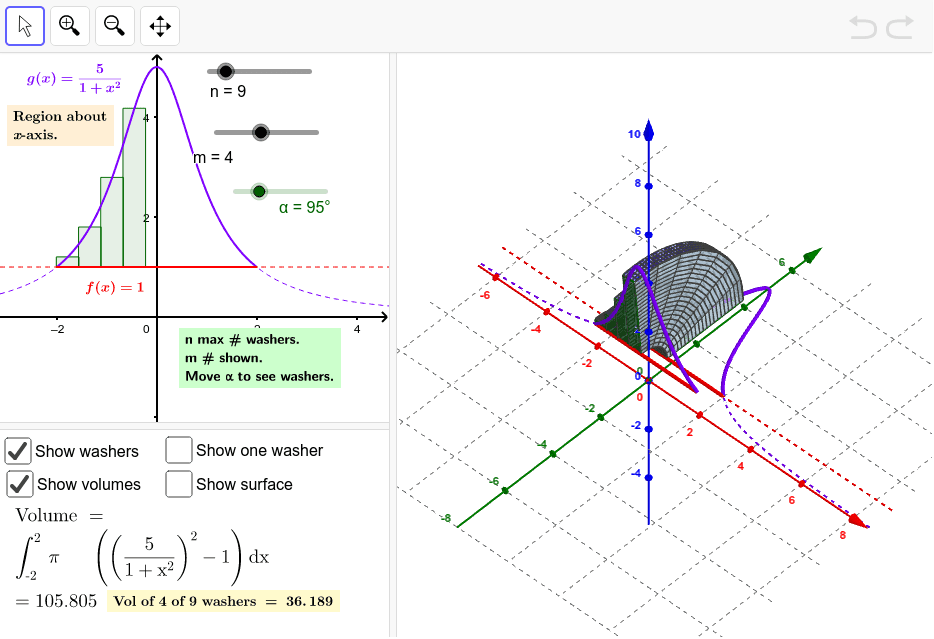
This example demonstrates the calculation of the volume of a solid of revolution from the 2007 AP Exam Problem 1b. Key mathematical concepts include integration and volume of solids of revolution. It is constructed using GeoGebra commands such as Sequence, Polygon, Rotate, and Integral. Suitable for high school math education and learning applications of integration in calculus.
GeoGebra Commands & Parameters
Sequence(Polygon[(-2 + (k * h), f(-2 + ((k + p) * h))), (-2 + ((k + 1) * h), f(-2 + ((k + p) * h))), (-2 + ((k + 1) * h), g(-2 + ((k + p) * h))), (-2 + (k * h), g(-2 + ((k + p) * h)))], k, 0, m - 1) → RectanglesPolygon((-2 + (DK * h), f(-2 + ((DK + p) * h))), (-2 + ((DK + 1) * h), f(-2 + ((DK + p) * h))), (-2 + ((DK + 1) * h), g(-2 + ((DK + p) * h))), (-2 + (DK * h), g(-2 + ((DK + p) * h)))) → Rectangle1, b, c, d, eRotate(Rectangle1, α, xAxis) → Rectangle1'Integral(A, -2, 2) → VolIntegRectangleSum(A, -2, -2 + (m * h), m, p) → WSSurface(u, (f(u) * cos(β)), (f(u) * sin(β)), u, -2, 2, β, 0, (2 * π)) → InnerSurface(u, (g(u) * cos(β)), (g(u) * sin(β)), u, -2, 2, β, 0, (2 * π)) → OuterSurface(-2 + (DK * h), (u * cos(β)), (u * sin(β)), u, f(-2 + ((DK + p) * h)), g(-2 + ((DK + p) * h)), β, 0, α) → SideLeft1Surface(-2 + ((DK + 1) * h), (u * cos(β)), (u * sin(β)), u, f(-2 + ((DK + p) * h)), g(-2 + ((DK + p) * h)), β, 0, α) → SideRight1Surface(-2 + u, (f(-2 + ((DK + p) * h)) * cos(β)), (f(-2 + ((DK + p) * h)) * sin(β)), u, (DK * h), ((DK + 1) * h), β, 0, α) → Inner1Surface(-2 + u, (g(-2 + ((DK + p) * h)) * cos(β)), (g(-2 + ((DK + p) * h)) * sin(β)), u, (DK * h), ((DK + 1) * h), β, 0, α) → Outer1Rotate(g_1, α, xAxis) → iRotate(f_1, α, xAxis) → jRotate(Rectangles, α, xAxis) → Rectangles'Sequence(Surface[-2 + u, (f(-2 + ((k + p) * h)) * cos(β)), (f(-2 + ((k + p) * h)) * sin(β)), u, (k * h), ((k + 1) * h), β, 0, α], k, 0, m - 1) → InnersSequence(Surface[-2 + u, (g(-2 + ((k + p) * h)) * cos(β)), (g(-2 + ((k + p) * h)) * sin(β)), u, (k * h), ((k + 1) * h), β, 0, α], k, 0, m - 1) → OutersSequence(Surface[-2 + (k * h), (u * cos(β)), (u * sin(β)), u, f(-2 + ((k + p) * h)), g(-2 + ((k + p) * h)), β, 0, α], k, 0, m - 1) → SidesLeftSequence(Surface[-2 + ((k + 1) * h), (u * cos(β)), (u * sin(β)), u, f(-2 + ((k + p) * h)), g(-2 + ((k + p) * h)), β, 0, α], k, 0, m - 1) → SidesRight