
Volume by Washers by Mike May (2)
Loading the math board and drawing, please wait…
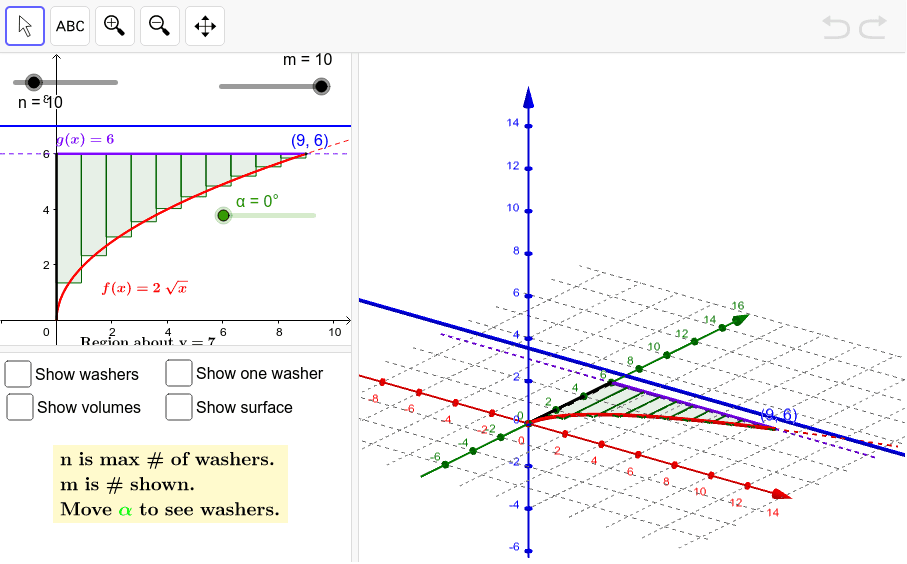
This example demonstrates the volume of a solid of revolution using the washer method, based on AP Exam 2010 Problem 4b. Key mathematical concepts include the volume of a solid of revolution and parabolas. GeoGebra commands used include Sequence, Polygon, Rotate, Integral, Surface, Segment, and RectangleSum. Suitable for high school mathematics education and learning.
GeoGebra Commands & Parameters
Sequence(Polygon[((k * h), f(((k + p) * h))), (((k + 1) * h), f(((k + p) * h))), (((k + 1) * h), g(((k + p) * h))), ((k * h), g(((k + p) * h)))], k, 0, m - 1) → RectanglesPolygon(((DK * h), f(((DK + p) * h))), (((DK + 1) * h), f(((DK + p) * h))), (((DK + 1) * h), g(((DK + p) * h))), ((DK * h), g(((DK + p) * h)))) → Rectangle1, b, c, d, eRotate(Rectangle1, α, a) → Rectangle1'Integral((π * ((7 - f(x))^(2) - (7 - g(x))^(2))), 0, 9) → VolIntegRotate(Rectangles, α, a) → Rectangles'Rotate(g_1, α, a) → iRotate(f_1, α, a) → jSurface(u, 7 - ((7 - g(((DK + p) * h))) * cos(β)), ((7 - g(((DK + p) * h))) * sin(β)), u, (DK * h), ((DK + 1) * h), β, 0, α) → Inner1Surface(u, 7 - ((7 - f(((DK + p) * h))) * cos(β)), ((7 - f(((DK + p) * h))) * sin(β)), u, (DK * h), ((DK + 1) * h), β, 0, α) → Outer1Surface((DK * h), 7 - ((7 - u) * cos(β)), ((7 - u) * sin(β)), u, f(((DK + p) * h)), g(((DK + p) * h)), β, 0, α) → SideLeft1Surface(((DK + 1) * h), 7 - ((7 - u) * cos(β)), ((7 - u) * sin(β)), u, f(((DK + p) * h)), g(((DK + p) * h)), β, 0, α) → SideRight1Surface(u, 7 + ((7 - g(u)) * cos(β)), ((7 - g(u)) * sin(β)), u, 0, 9, β, 0, (2 * π)) → InnerSurface(u, 7 - ((7 - f(u)) * cos(β)), ((7 - f(u)) * sin(β)), u, 0, 9, β, 0, (2 * π)) → OuterSegment((0, 0, 0), (0, 6, 0)) → kRotate(k, α, a) → k'Sequence(Surface[u, 7 - ((7 - g(((k + p) * h))) * cos(β)), ((7 - g(((k + p) * h))) * sin(β)), u, (k * h), ((k + 1) * h), β, 0, α], k, 0, m - 1) → InnersSequence(Surface[u, 7 - ((7 - f(((k + p) * h))) * cos(β)), ((7 - f(((k + p) * h))) * sin(β)), u, (k * h), ((k + 1) * h), β, 0, α], k, 0, m - 1) → OutersSequence(Surface[(k * h), 7 - ((7 - u) * cos(β)), ((7 - u) * sin(β)), u, f(((k + p) * h)), g(((k + p) * h)), β, 0, α], k, 0, m - 1) → SidesLeftSequence(Surface[((k + 1) * h), 7 - ((7 - u) * cos(β)), ((7 - u) * sin(β)), u, f(((k + p) * h)), g(((k + p) * h)), β, 0, α], k, 0, m - 1) → SidesRightRectangleSum(A, 0, (m * h), m, p) → WS
AI Drawing Prompt Reference
Draw a diagram illustrating the volume calculation of a solid of revolution using the washer method. Include several rectangles and surfaces formed by rotating parabolas, with integrals to calculate the volume. Start by plotting a sequence of rectangles, then rotate and combine them into washers. Next, draw the inner and outer surfaces of the solid, and finally combine integral lines and surfaces to display the entire solid, showing the volume calculation process.
The prompt above was compiled from the original drawing commands and is for reference only.