
Volume by Shells Example
Loading the math board and drawing, please wait…
In collections
AP Calculus volume problems
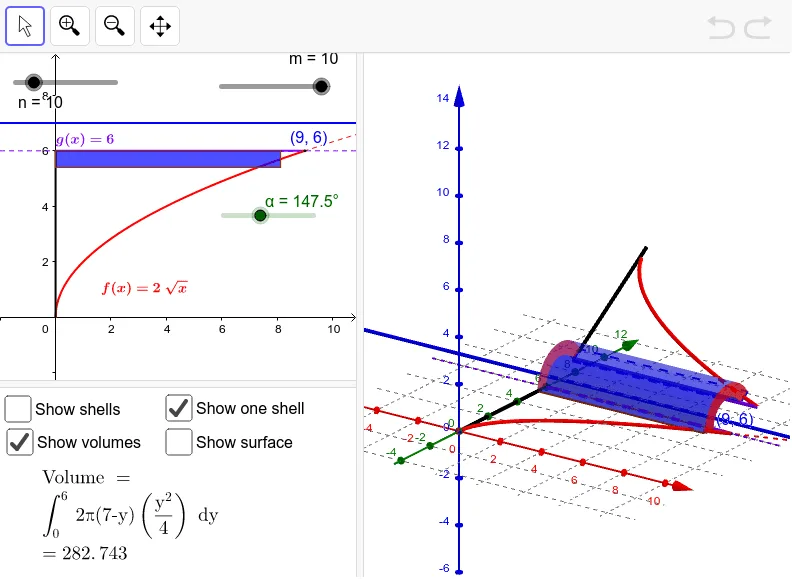
This example demonstrates how to calculate the volume of a solid of revolution using the shell method. It involves core calculus concepts such as integral computation, volume of solids of revolution, and the application of the shell method. Key GeoGebra commands and objects used in the construction include Segment, Polygon, Rotate, Integral, Sequence, Surface, and RectangleSum to model the rotating solid, generate shells, and compute the integral. Suitable for high school and above students learning calculus, particularly those needing to understand methods for calculating volumes of revolution.
GeoGebra Commands & Parameters
Segment((0, 0, 0), (0, 6, 0)) → kPolygon((0, (DK * h), 0), (0, ((DK + 1) * h), 0), (H(((DK + p) * h)), ((DK + 1) * h), 0), (H(((DK + p) * h)), (DK * h), 0)) → Rectangle1, b, c, d, eRotate(Rectangle1, α, a) → Rectangle1'Integral((((2 * π) * R(y)) * H(y)), 0, 6) → VolIntegSequence(Polygon[(0, (k * h), 0), (0, ((k + 1) * h), 0), (H(((k + p) * h)), ((k + 1) * h), 0), (H(((k + p) * h)), (k * h), 0)], k, 0, m - 1) → RectanglesRotate(Rectangles, α, a) → Rectangles'Rotate(g_1, α, a) → iRotate(f_1, α, a) → jSurface(u, 7 + ((7 - g(u)) * cos(β)), ((7 - g(u)) * sin(β)), u, 0, 9, β, 0, (2 * π)) → InnerSurface(u, 7 - ((7 - f(u)) * cos(β)), ((7 - f(u)) * sin(β)), u, 0, 9, β, 0, (2 * π)) → OuterRotate(k, α, a) → k'RectangleSum((((2 * π) * R(x)) * H(x)), 0, (m * h), m, p) → VShSequence(Surface[(u * H(((k + p) * h))), 7 - ((7 - (k * h)) * cos(β)), ((7 - (k * h)) * sin(β)), u, 0, 1, β, 0, α], k, 0, m - 1) → OutersSequence(Surface[(u * H(((k + p) * h))), 7 - ((7 - ((k + 1) * h)) * cos(β)), ((7 - ((k + 1) * h)) * sin(β)), u, 0, 1, β, 0, α], k, 0, m - 1) → InnersSequence(Surface[0, 7 - ((7 - ((k + u) * h)) * cos(β)), ((7 - ((k + u) * h)) * sin(β)), u, 0, 1, β, 0, α], k, 0, m - 1) → SidesLeftSequence(Surface[H(((k + p) * h)), 7 - ((7 - ((k + u) * h)) * cos(β)), ((7 - ((k + u) * h)) * sin(β)), u, 0, 1, β, 0, α], k, 0, m - 1) → SidesRightSurface((u * H(((DK + p) * h))), 7 - ((7 - ((DK + 1) * h)) * cos(β)), ((7 - ((DK + 1) * h)) * sin(β)), u, 0, 1, β, 0, α) → Inner1Surface((u * H(((DK + p) * h))), 7 - ((7 - (DK * h)) * cos(β)), ((7 - (DK * h)) * sin(β)), u, 0, 1, β, 0, α) → Outer1Surface(0, 7 - ((7 - ((DK + u) * h)) * cos(β)), ((7 - ((DK + u) * h)) * sin(β)), u, 0, 1, β, 0, α) → SideLeft1Surface(H(((DK + p) * h)), 7 - ((7 - ((DK + u) * h)) * cos(β)), ((7 - ((DK + u) * h)) * sin(β)), u, 0, 1, β, 0, α) → SideRight1