
Volume and Surface Area of a Pyramid
Loading the math board and drawing, please wait…
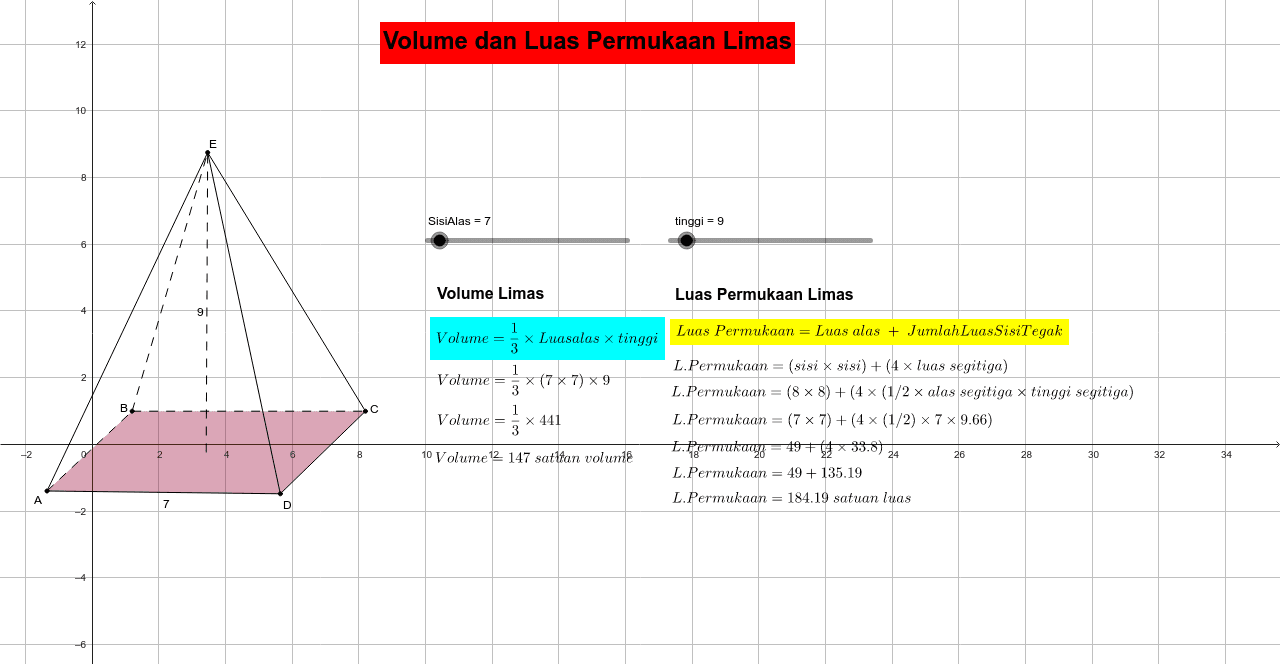
① This GeoGebra example dynamically demonstrates the volume and surface area of a pyramid (Limas), showing the 3D solid and its measurements. ② Core math concepts include the volume formula V = (1/3) × base area × height, and surface area as the sum of the base area and the areas of lateral triangular faces, involving spatial reasoning and metric calculations in solid geometry. ③ Construction highlights: using GeoGebra commands such as Point, Segment, Midpoint, and Polygon to build the base polygon, apex, and lateral edges; objects like SisiAlas (base), Luasalas (base area), Volumelimas (volume), Tinggisegitiga (height of lateral triangle) are defined, with text objects (teks) displaying computed values for dynamic updates. ④ Suitable for middle and high school geometry classes, particularly for teaching pyramid properties, formula derivation, and spatial measurement, and for interactive classroom demonstrations or student exploration.
GeoGebra Commands & Parameters
Point(Circle[A, salas]) → BPoint(Circle[B, SisiAlas]) → CPoint(Circle[A, SisiAlas]) → DSegment(B, D) → bMidpoint(b) → RPoint(Circle[R, tinggi]) → ESegment(A, D) → cSegment(A, B) → dSegment(B, C) → eSegment(C, D) → fSegment(A, E) → gSegment(B, E) → hSegment(D, E) → iSegment(C, E) → jPolygon(A, B, C, D) → poli1, a, b_1, c_1, d_1Segment(R, E) → k
AI Drawing Prompt Reference
Draw a square pyramid with a square base. Connect the four base vertices to form the base polygon. Place an apex directly above the center of the base, and connect the apex to each base vertex with line segments to form the lateral edges. Also draw a vertical segment from the base center to the apex to represent the height. Label the base area, lateral face height, volume, and surface area. Show the 3D solid with its measurements.
The prompt above was compiled from the original drawing commands and is for reference only.