
Viviani's Theorem Exploration
Loading the math board and drawing, please wait…
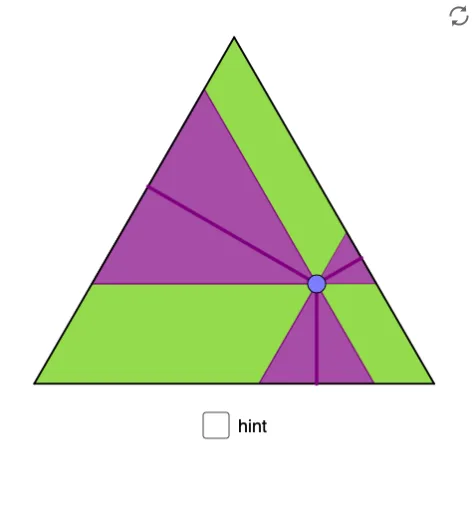
This example demonstrates Viviani's Theorem, showing the sum of distances from a point inside a cube to its three coordinate planes equals the cube's altitude. It involves core concepts in solid geometry, vectors, derivatives, and geometric constructions. The construction uses commands like Polygon, Point, Circle, Intersect, Line, etc., from GeoGebra. Ideal for high school and above students exploring geometric theorems.
GeoGebra Commands & Parameters
Polygon(B, C, 3) → poly1, a, b, c, APoint(a) → UCircle(U, 0.01) → f_1Intersect(f_1, b, 1) → ZLine(Z, a) → h_2Intersect(h_2, c) → A_1Intersect(f_1, a, 1) → VLine(V, b) → g_2Intersect(g_2, c) → WPolygon(W, A_1, V) → t1, i_2, k_2, n_2PointIn(t1) → MOrthogonalLine(M, b) → dOrthogonalLine(M, a) → eOrthogonalLine(M, c) → fIntersect(d, b) → PIntersect(e, a) → NIntersect(f, c) → QSegment(M, P) → gSegment(M, Q) → hSegment(M, N) → iSegment(A, Q) → jSegment(B, N) → kSegment(C, P) → lAngle(M, Q, A) → αAngle(M, P, C) → βAngle(M, N, B) → γSegment(A, M) → pSegment(B, M) → qSegment(M, C) → rRotate(P, 30°, M) → P'Angle(P, M, P') → δRay(M, P') → sIntersect(b, s) → DIntersect(i, poly1) → E, E_1Polygon(D, M, 3) → poly2, t, a_1, b_1, FSegment(M, F) → c_1Segment(M, D) → d_1OrthogonalLine(D, a_1) → e_1Intersect(a_1, c_1) → GIntersect(a_1, c_1) → HIntersect(e_1, a_1) → IRotate(N, 30°, M) → N'Angle(N, M, N') → εRay(M, N') → g_1Intersect(a, g_1) → JPolygon(J, M, 3) → poly3, h_1, i_1, j_1, KLine(M, a) → k_1Intersect(c, k_1) → LPolygon(L, M, 3) → poly4, l_1, m_1, n_1, OOrthogonalLine(O, k_1) → p_1Intersect(k_1, p_1) → RSegment(O, R) → q_1Segment(M, K) → r_1Segment(M, J) → s_1Segment(D, A) → t_1Point(t_1) → SVector(D, S) → uTranslate(poly2, u) → poly2'Translate(D, u) → D'Translate(I, u) → I'Segment(D', I') → a_2Translate(M, u) → M'Translate(F, u) → F'Segment(M', F') → b_2Mirror(J, N) → J'Polygon(B, L, M, J') → q1, b_3, l_2, m_2, j'Polygon(A, O, M', S) → q2, a_3, o_1, m', s_2Point(b) → TPolygon(M, F, T, J) → q3, m_3, f_2, t_2, j_2Translate(M, u) → M'_1Translate(P, u) → P'_1Segment(M'_1, P'_1) → g'
AI Drawing Prompt Reference
Draw a point inside a cube and show that the sum of its distances to the three coordinate planes equals the cube's height. Start by constructing the cube, then draw perpendicular segments from the point to each coordinate plane. Calculate the lengths of these segments and intersect them with the cube's edges to form new shapes. Finally, use rotations and intersections to illustrate the relationships between these shapes, demonstrating Viviani's theorem.
The prompt above was compiled from the original drawing commands and is for reference only.