
Visualizing Triangle Inequalities
Loading the math board and drawing, please wait…
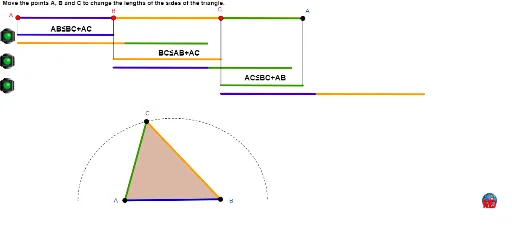
This example dynamically demonstrates the relationship between the sides of a triangle, visually illustrating the triangle inequality theorem. It involves core math concepts like triangle inequalities, vectors, and coordinate geometry. Construction uses commands such as Segment, Point, Circle, Intersect, Locus, Midpoint, Vector, Translate, Mod, Polygon. Suitable for high school mathematics teaching and geometric construction learning.
GeoGebra Commands & Parameters
Segment(A, B_1) → aPoint(a) → BSegment(A, B) → bPoint(a) → CSegment(B, C) → cSegment(C, B_1) → dCircle(E, b) → ePoint(e) → FSegment(E, F) → fCircle(F, c) → gCircle(E, d) → hIntersect(g, h) → G, H, ,Segment(E, H) → iSegment(F, H) → jLocus(H, C) → lieu1Midpoint(b) → DVector(A, I) → uTranslate(A, u) → A'_1Translate(B, u) → B'_1Segment(A'_1, B'_1) → b'_1Vector(B, J) → vTranslate(B, v) → B'_2Translate(C, v) → C'_1Segment(B'_2, C'_1) → c'_1Vector(C, C'_1) → wTranslate(C, w) → C'_2Translate(B_1, w) → LSegment(C'_2, L) → d'_1Vector(B, K) → zTranslate(B, z) → B'_3Translate(C, z) → C'_3Segment(B'_3, C'_3) → c'_2Vector(A, M) → kTranslate(A, k) → A'_2Translate(B, k) → B'_4Segment(A'_2, B'_4) → b'_2Vector(C, B'_4) → lTranslate(C, l) → C'_4Translate(B_1, l) → OSegment(C'_4, O) → d'_2Vector(C, P) → mTranslate(C, m) → C'_5Translate(B_1, m) → QSegment(C'_5, Q) → d'Vector(A, R) → nTranslate(A, n) → A'Translate(B, n) → B'_5Segment(A', B'_5) → b'Vector(B, B'_5) → pTranslate(B, p) → B'Translate(C, p) → C'Segment(B', C') → c'Midpoint(b'_1) → TMidpoint(c'_2) → UMidpoint(d') → VSegment(A, I) → rSegment(B, B'_1) → qSegment(B, B'_3) → sSegment(C, C'_3) → t_1Segment(C, C'_5) → a_1Segment(B_1, Q) → b_1Midpoint(B'_2, L) → NSegment(S, W) → c_1Mod(t, 2) → aaPolygon(H, F, E) → poly1, e_1, h_1, f_1
AI Drawing Prompt Reference
Draw a triangle and visualize the relationship between its sides. Start by constructing the triangle's three sides. Then, draw a circle with one side as the radius and another circle with the other side as the radius. The intersection points of these circles will help determine the third vertex. Next, find the midpoint and vectors, use vector translation to create parallelograms, and finally display the relationships among these geometric elements to illustrate the triangle inequality theorem.
The prompt above was compiled from the original drawing commands and is for reference only.