
Visualizing the Sum Rule for Derivatives
Loading the math board and drawing, please wait…
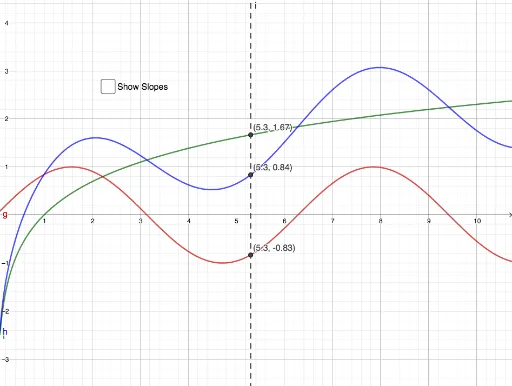
① This example dynamically demonstrates the sum rule for derivatives: the derivative of a sum of two functions equals the sum of their derivatives. ② Core mathematical concepts include differentiation rules, tangent lines, and slope interpretation in calculus. ③ Construction highlights: using GeoGebra commands Intersect to find intersection points, Tangent to draw tangent lines, and Slope to compute slopes; objects include functions f, g, h (where h = f + g), tangent lines, and slope segments, with sliders or draggable points to explore changes. ④ Suitable for high school or introductory college calculus students to grasp the geometric meaning of linearity in differentiation, and useful for classroom demonstrations.
GeoGebra Commands & Parameters
Intersect(g, i, (5.3, -0.8322674422239013)) → AIntersect(h, i, (5.3, 0.8354393783341748)) → BIntersect(f, i, (5.3, 1.667706820558076)) → CTangent(A, g) → jTangent(B, h) → kTangent(C, f) → lSlope(l) → mSlope(k) → m_1Slope(j) → m_2