
Reflectional Symmetry of Regular Polygons
Loading the math board and drawing, please wait…
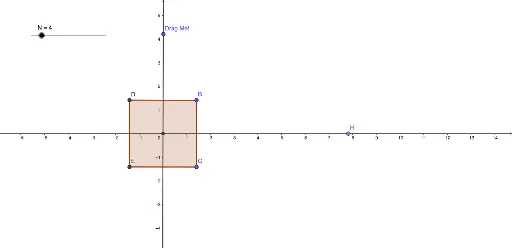
This example demonstrates the reflectional symmetry of regular polygons by showing the symmetry axes and corresponding points through mirror operations. Key math concepts include symmetry axes, isosceles triangles, secant lines, piecewise functions, cubes, and indefinite integrals. GeoGebra commands used in construction are Intersect, Polygon, Point, Line, and Mirror. Suitable for high school mathematics teaching to understand the principles of geometric transformations combined with function graphs and symmetry properties.
GeoGebra Commands & Parameters
Intersect(xAxis, yAxis) → APolygon(C, B, N) → poly1, f, p, D, E, F, I, J, K, L, M, g, h, i, j, k, l, m, nPoint(xAxis) → HLine(G, A) → qMirror(poly1, q) → poly1'
AI Drawing Prompt Reference
Draw a regular polygon and display its symmetry axes, showing the symmetry through mirror operations. First, find the intersection point of the x-axis and y-axis in the coordinate system, then draw a regular polygon centered at this point. Next, draw a line from the center point to the x-axis, which is one of the symmetry axes. Finally, perform a mirror operation on the polygon along this axis to obtain a mirrored polygon, visually demonstrating the reflective symmetry of the regular polygon.
The prompt above was compiled from the original drawing commands and is for reference only.