
Visualizing the Commutative Property of Multiplication
Loading the math board and drawing, please wait…
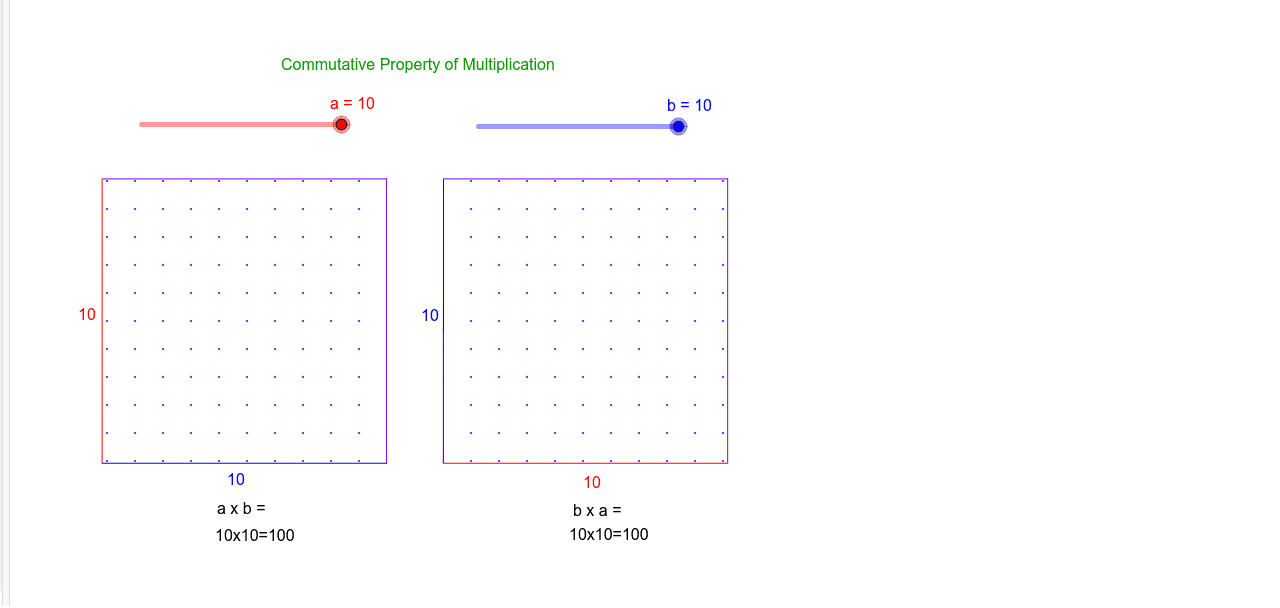
This GeoGebra example dynamically illustrates the commutative property of multiplication: changing the order of factors does not change the product. The core mathematical concept is the commutative law (a×b = b×a), a fundamental property of arithmetic operations. The construction uses commands such as Intersect, Point, Segment, OrthogonalLine, Polygon, and PointIn to build rectangular area models, where the product is represented by polygon areas. Text objects (text1 to text5) display numerical values or formulas. Suitable for upper elementary to middle school students learning multiplication properties, and useful for teachers as a visual demonstration to help students grasp the intuitive meaning of commutativity through geometric area comparison.
GeoGebra Commands & Parameters
Intersect(xAxis, yAxis) → APoint(Circle[A, a]) → BSegment(A, B) → a_3Point(Circle[A, b]) → CSegment(A, C) → b_4OrthogonalLine(C, b_4) → eOrthogonalLine(B, a_3) → fIntersect(f, e) → DPolygon(A, B, D, C) → poly1, a_1, b_1, d_1, b_3Point(xAxis) → EPoint(Circle[E, b_4]) → FSegment(E, F) → cPoint(Circle[E, a_3]) → GSegment(E, G) → dOrthogonalLine(F, yAxis) → gOrthogonalLine(G, xAxis) → hIntersect(g, h) → HPolygon(E, F, H, G) → poly2, e_1, f_1, h_1, g_1PointIn(poly1) → Pointpoly1
AI Drawing Prompt Reference
Please draw two rectangles to illustrate the commutative property of multiplication. The first rectangle is formed by the intersection of the x-axis and y-axis (point A), point B (on a circle centered at A with radius a), point C (on a circle centered at A with radius b), and point D (from the intersection of perpendicular lines). The second rectangle is formed by a point E on the x-axis, point F (on a circle centered at E with radius b_4), point G (on a circle centered at E with radius a_3), and point H (from the intersection of perpendicular lines). The drawing order should be: first determine point A, then draw two circles to get points B and C, then find point D via perpendicular lines, then draw the first rectangle; next determine point E on the x-axis, then draw two circles to get points F and G, find point H via perpendicular lines, and finally draw the second rectangle. The two rectangles should clearly show equal areas to demonstrate the commutative property intuitively.
The prompt above was compiled from the original drawing commands and is for reference only.