
Visualizing Fraction Addition and Subtraction by Mathguru
Loading the math board and drawing, please wait…
In collections
Fracions
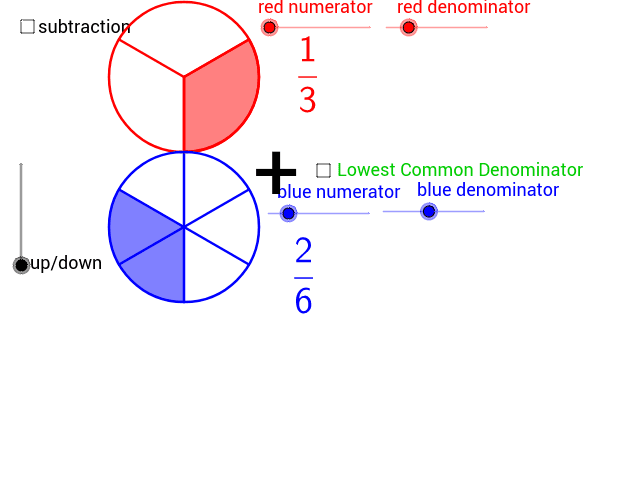
This example demonstrates fraction addition and subtraction using two adjustable circular models, showing how unlike denominators are converted to a common denominator, numerators are combined, and the result is simplified. It covers fraction units, common denominators, least common multiple, greatest common divisor, vector translation, geometric transformations, and sector/circle-area visualization. The construction uses Circle to create the fraction circles, Sequence to generate repeated sectors or markers, Vector and Translate to move and combine slices, and LCM/GCD to compute the common denominator and reduce the final fraction. Objects such as numeratorR, denominatorR, LCMdenominator, cutR, shadeR, and shiftcircle support dynamic display of the adding and subtracting process. Suitable for upper elementary and middle school mathematics, teacher demonstrations, and interactive fraction visualization.
GeoGebra Commands & Parameters
Circle(centerR, radius) → circleRCircle(centerB, radius) → circleBLCM(denominatorR, denominatorB) → LCMdenominatorSequence(Segment[centerR, Rotate[AR, radius°, centerR]], radius, 360 / denominatorR, 360, 360 / denominatorR) → cutRSequence(Segment[centerB, Rotate[AB, radius°, centerB]], radius, 360 / denominatorB, 360, 360 / denominatorB) → cutBSequence(CircleSector[centerR, Rotate[AR, radius°, centerR], Rotate[AR, (radius + 360 / denominatorR)°, centerR]], radius, 0, 360 / denominatorR * numeratorR - 360 / denominatorR, 360 / denominatorR) → shadeRSequence(CircleSector[centerB, Rotate[AB, (-radius - 360 / denominatorB)°, centerB], Rotate[AB, (-radius)°, centerB]], radius, 0, 360 / denominatorB * numeratorB - 360 / denominatorB, 360 / denominatorB) → shadeBSequence(Segment[centerR, Rotate[AR, radius°, centerR]], radius, 0, 360, 360 / LCMdenominator) → cutLCMRSequence(Segment[centerB, Rotate[AB, radius°, centerB]], radius, 0, 360, 360 / LCMdenominator) → cutLCMBVector(centerB, A) → uVector(centerB, B) → vTranslate(circleB, Vector[showfinal * u]) → total0Translate(cutLCMB, Vector[showfinal * u]) → cuttotal0Sequence(CircleSector[centerB, Rotate[AB, (-radius - 360 / denominatorB)°, centerB], Rotate[AB, (-radius)°, centerB]], radius, 0, 360 / denominatorB * numeratorB - 360 / denominatorB, 360 / denominatorB) → ETranslate(shadeB, Vector[showfinal * u]) → FSequence(CircleSector[centerB, Rotate[AB, radius°, centerB], Rotate[AB, (radius + 360 / denominatorR)°, centerB]], radius, 0, 360 / denominatorR * numeratorR - 360 / denominatorR, 360 / denominatorR) → HTranslate(H, Vector[showfinal * u]) → IVector(centerB, J) → wTranslate(circleB, Vector[showfinal * w]) → DTranslate(cutLCMB, Vector[showfinal * w]) → KSequence(CircleSector[centerB, Rotate[AB, radius°, centerB], Rotate[AB, (radius + 360 / LCMdenominator)°, centerB]], radius, (LCMdenominator - LCMnumeratorB) * 360 / LCMdenominator, 360 / LCMdenominator * (M + LCMdenominator - LCMnumeratorB - 1), 360 / LCMdenominator) → NTranslate(N, Vector[showfinal * v]) → OGCD(LCMnumerator, LCMdenominator) → PTranslate(circleB, Vector[showfinal * u]) → CTranslate(cutLCMB, Vector[showfinal * u]) → QSequence(CircleSector[centerB, Rotate[AB, radius°, centerB], Rotate[AB, (radius + 360 / LCMdenominator)°, centerB]], radius, LCMnumeratorB * 360 / LCMdenominator, 360 / LCMdenominator * (LCMnumeratorR - 1), 360 / LCMdenominator) → RTranslate(R, Vector[showfinal * u]) → SSequence(CircleSector[centerB, Rotate[AB, radius°, centerB], Rotate[AB, (radius + 360 / denominatorB)°, centerB]], radius, 0, 360 / denominatorB * numeratorB - 360 / denominatorB, 360 / denominatorB) → TTranslate(circleB, Vector[showfinal * v]) → UTranslate(cutLCMB, Vector[showfinal * v]) → V
AI Drawing Prompt Reference
Please draw a model that demonstrates fraction addition and subtraction using adjustable circles. First, create two circles to represent two fractions, each circle distinguished by different colors. Then, divide these circles into equal parts, with each part representing the denominator of the fraction. Next, use the least common multiple (LCM) to calculate a common denominator and convert both fractions to have the same denominator. Through vector translation and geometric transformations, combine and move the sectors of these circles to illustrate the addition and subtraction process. Finally, simplify the result and display the final fraction. The entire construction includes creating circles, generating repeated sectors or markers, using vectors and translations to move and combine slices, and calculating the greatest common divisor (GCD) to simplify the result.
The prompt above was compiled from the original drawing commands and is for reference only.