
Visual Fraction Comparison Tool
Loading the math board and drawing, please wait…
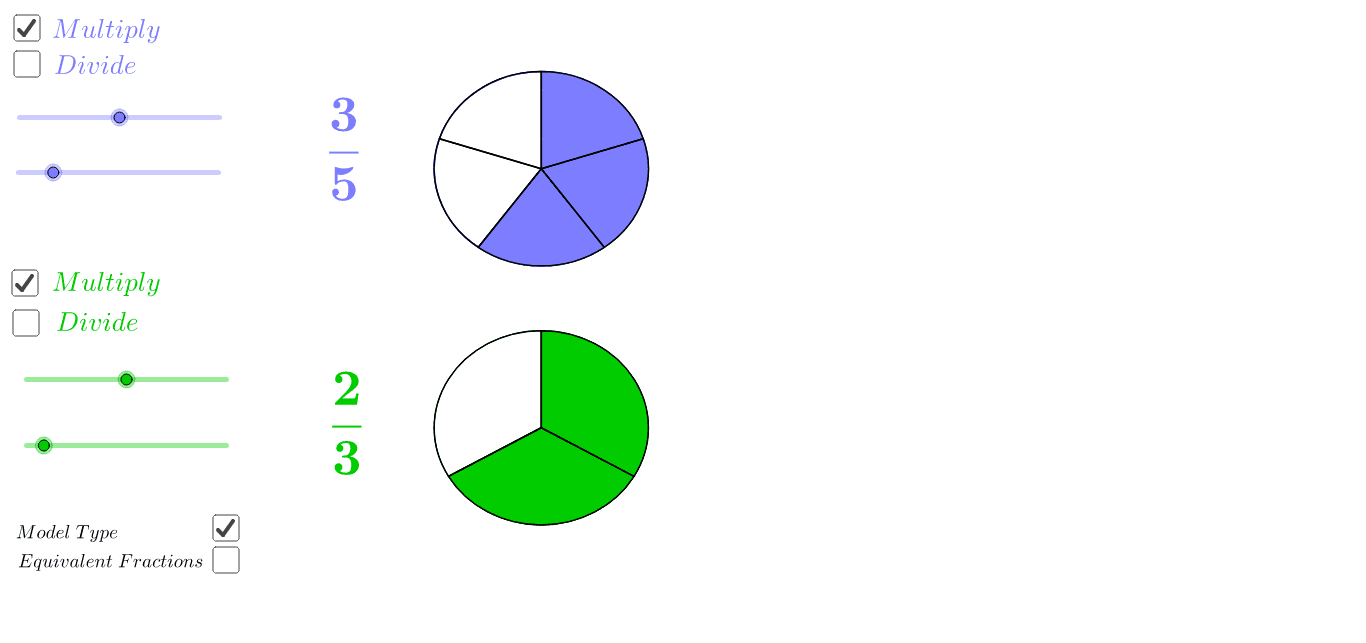
This GeoGebra example demonstrates how to visually compare two fractions using bar charts (BarFraction command). The construction involves drawing reference circles with the Circle tool, generating sequence data via Sequence command, and performing geometric transformations using Translate. Core mathematical concepts include fraction comparison, inequality relationships, and proportional analysis. Key construction points: ①Using If command for conditional logic; ②Converting fractions to bar lengths through BarFraction; ③Generating multiple fraction sequences with Sequence; ④Achieving alignment via Translate. Suitable for upper elementary to middle school mathematics teaching, ideal for classroom demonstration of fraction comparison, helping students develop number-sense thinking and understand relative magnitude of fractions.
GeoGebra Commands & Parameters
If(m, (a_1 * b), If[d, a_1 / b, If[a, a_1 + b, If[s, a_1 - b]]]) → iIf(m, (n * g), If[d, n / g, If[a, n + g, If[s, n - g]]]) → jDivision(a_1, n) → list8Intersect(xAxis, yAxis) → APoint(yAxis) → BSequence(Rotate[B, (((-i) * 360) * ° / n), A], i, 0, n) → list1Circle(A, B) → cSequence(Rotate[D, (((-i) * 360) * ° / If[m, (n * g), If[d, n / g, If[a, n + g, If[s, n - g]]]]), C], i, 0, If[m, (n * g), If[d, n / g, If[a, n + g, If[s, n - g]]]]) → list4Circle(C, D) → fSequence(Sector[c, Element[list1, i + 1], Element[list1, i]], i, 1, n) → list2Sequence(Sector[f, Element[list4, i + 1], Element[list4, i]], i, 1, If[m, (n * g), If[d, n / g, If[a, n + g, If[s, n - g]]]]) → list5Division(i, j) → list11If(n > a_1, Sequence[Sector[c, Element[list1, i + 1], Element[list1, i]], i, 1, a_1], Sequence[Sector[c, Element[list1, i + 1], Element[list1, i]], i, 1, a_1]) → list3Circle(E, G) → pCircle(F, H) → qSequence(Rotate[G, (((-i) * 360) * ° / o), E], i, 0, o) → list14Sequence(Sector[p, Element[list14, i + 1], Element[list14, i]], i, 1, o) → list12If(l > o, Sequence[Sector[p, Element[list14, i + 1], Element[list14, i]], i, 1, l], Sequence[Sector[p, Element[list14, i + 1], Element[list14, i]], i, 1, l]) → list15Sequence(Sector[p, Element[list14, i + 1], Element[list14, i]], i, 1, o) → list16Sequence(Rotate[H, (((-i) * 360) * ° / If[u, (o * t), If[w, o / t, If[a, o + t, If[s, o - t]]]]), F], i, 0, If[u, (o * t), If[w, o / g, If[a, o + t, If[s, o - t]]]]) → list17Sequence(Sector[q, Element[list17, i + 1], Element[list17, i]], i, 1, If[u, (o * t), If[w, o / t, If[a, o + t, If[s, o - t]]]]) → list18If(u, (l * r), If[w, l / r, If[a, a_1 + b, If[s, a_1 - b]]]) → b_1If(u, (o * t), If[w, o / t, If[a, n + g, If[s, n - g]]]) → c_1Division(b_1, c_1) → list20Sequence(Element[list10, i] - (0, 8), i, 1, Length[list10]) → list22If(j ≥ i, Sequence[Sector[f, Element[list4, n + 1], Element[list4, n]], n, 1, i], Sequence[Sector[f, Element[list4, i + 1], Element[list4, i]], i, 1, Element[list11, 2]]) → list6If(i > j, Sequence[Circle[Element[list10, i], 0.8], i, 0, Element[list11, 1], 1]) → list9If(b_1 > c_1, Sequence[Circle[Element[list22, i], 0.8], i, 0, Element[list20, 1], 1]) → list21Translate({list3, list15}, (v, 0)) → list13Translate({list6}, (0, g_1)) → list23BarFraction(a_1, n, I) → list24, list25BarFraction(l, o, J) → list26, list27If(m ≟ 1, (a_1 * b), a_1 / b) → r_5If(m ≟ 1, (n * g), n / g) → s_5If(u ≟ 1, (o * t), o / t) → v_5If(u ≟ 1, (l * r), l / r) → t_5Translate(list24, (v, ((1 / 20 * v) * (v - 8)))) → list25'Translate(list26, (v, ((1 / 20 * v) * (v - 8)))) → list26'If(c_1 ≥ b_1, Sequence[Sector[q, Element[list17, o + 1], Element[list17, o]], o, 1, b_1], Sequence[Sector[q, Element[list17, i + 1], Element[list17, i]], i, 1, Element[list20, 2]]) → list19Improp(v_5, t_5, L) → list31_3, list31, list32If(t_5 > v_5, Sequence[Polygon[P - (0, i), P - (0, i) + (3, 0), P - (0, i) + (3, 0.5), P - (0, i) + (0, 0.5)], i, 0, Element[list32, 1] - 1]) → list30If(t_5 > v_5, Sequence[Polygon[P - (0, i), P - (0, i) + (3, 0), P - (0, i) + (3, 0.5), P - (0, i) + (0, 0.5)], i, 0, Element[list32, 1] - 1]) → list33Improp(s_5, r_5, K) → list28, list29, list34If(r_5 > s_5, Sequence[Polygon[O - (0, i), O - (0, i) + (3, 0), O - (0, i) + (3, 0.5), O - (0, i) + (0, 0.5)], i, 0, Element[list34, 1] - 1]) → list35If(r_5 > s_5, Sequence[Polygon[O - (0, i), O - (0, i) + (3, 0), O - (0, i) + (3, 0.5), O - (0, i) + (0, 0.5)], i, 0, Element[list34, 1] - 1]) → list36If(i > j, Sequence[Circle[Element[list10, i], 0.8], i, 0, Element[list11, 1], 1]) → list37If(b_1 > c_1, Sequence[Circle[Element[list22, i], 0.8], i, 0, Element[list20, 1], 1]) → list38Translate(list28, (0, (1.045 * g_1))) → list28'
AI Drawing Prompt Reference
Create a visual comparison of two fractions: each fraction is shown by a circle divided into proportional sectors and a horizontal bar chart whose length matches the fraction value; the two bar charts are placed side by side and horizontally aligned via translation. Conditional logic selects one of four operations (multiply, divide, add, subtract) to compute numerators and denominators, and the sector sequences update automatically. When a fraction is improper, rectangular blocks are added above the bar to represent the whole-number part. The layout is symmetric, with distinct colors for the two fractions to highlight their relative magnitude.
The prompt above was compiled from the original drawing commands and is for reference only.