
Vidal Symmetric String Art: Rotational and Mirror Geometry
Loading the math board and drawing, please wait…
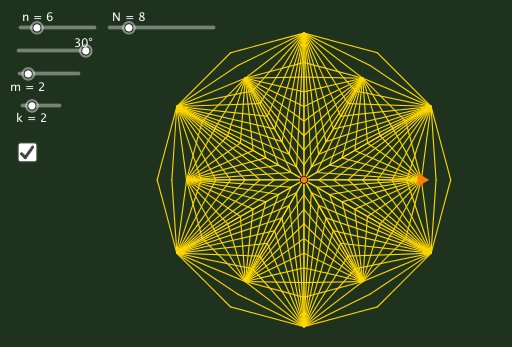
① This example demonstrates how to generate a symmetric string-art pattern within a general quadrilateral by combining rotations and mirror reflections, producing an intricate web of line segments with visual symmetry. ② Core mathematical concepts include symmetry, sequences, rotation transformations, mirror reflections, properties of general quadrilaterals, addition, and random experiments, blending deterministic structure with subtle variation. ③ Construction highlights: using GeoGebra commands such as Point, Rotate, Sequence, and Mirror; key objects include n (parameter), A, B, B', N, list1, list1', list2, a, m, b, k, list4, and c. Sliders control the number of points and symmetry layers, allowing dynamic exploration of the pattern's evolution. ④ Suitable for upper secondary to early university students, this example serves as an engaging bridge between mathematics and art, ideal for lessons on transformations, sequences, and geometric design, fostering appreciation for symmetry and algorithmic creativity.
GeoGebra Commands & Parameters
Point(Ray[A, A + (1, 0)]) → BRotate(B, (180 * ° / n), A) → B'Sequence(Segment[B, A + (i / N * (B' - A))], i, 0, N) → list1Mirror(list1, Line[A, B]) → list1'Sequence(Rotate[{list1, list1'}, ((i * 360) * ° / n), A], i, 0, n - 1) → list2Sequence(Rotate[kites[A, B + ((((i - 1) * k) * a) * (B - A) / Distance[B, A]), n, N + (k * (i - 1))], ((i - 1) * b), A], i, 1, m) → list4