
Vertical Translations of a Quadratic Function
Loading the math board and drawing, please wait…
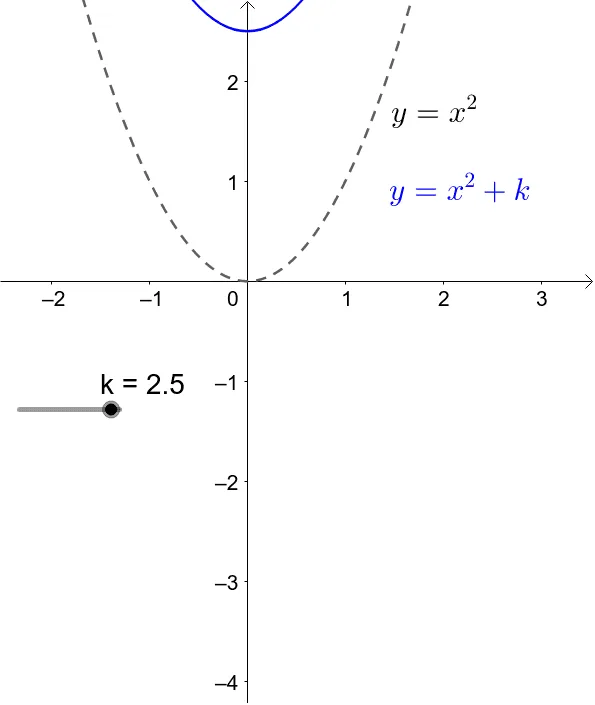
①This example demonstrates how a quadratic function's graph moves vertically along the y-axis when a constant is added to or subtracted from the function, using an interactive slider. ②The core mathematical concept is function transformation, specifically vertical translation, which changes the vertex position while preserving the parabola's shape and axis of symmetry. ③Construction details: Based on the summary, objects k, c, d, text1, and text2 are used; c likely represents the translation amount controlled by a slider or input, k and d may define coefficients or auxiliary lines, and text1/text2 display the updated function equation and vertex coordinates dynamically. ④This is suitable for middle school (grades 8-9) or early high school students learning quadratic functions, and serves as an effective visual aid for classroom instruction or self-study to grasp the effect of the constant term on the graph.
GeoGebra Commands & Parameters
Numeric k(2.5)y = x^(2)Conic d