
Vertical Angles Exploration: Dynamic Geometry Construction
Loading the math board and drawing, please wait…
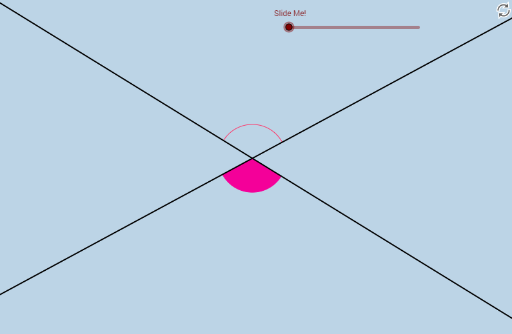
① This GeoGebra example dynamically demonstrates the vertical angles formed by two intersecting lines and their equality, using sectors and arcs to visually mark the angle measures. ② Core mathematical concepts include the definition of vertical angles, angle measurement, properties of intersecting lines, and the invariance of angles under transformations such as rotation and translation. ③ Construction highlights: Based on the summary, commands such as Point, Line, Intersect, Angle, Circle, CircleSector, CircleArc are used, along with transformations like Rotate, Dilate, Translate, and Vector, to build interactive angle and arc markers. Additionally, exponential and trigonometric functions are included, possibly to support angle calculations or dynamic variation. ④ Suitable for middle school geometry lessons or high school review, this example helps students intuitively grasp the vertical angles theorem and serves as a reference for designing dynamic geometry courseware.
GeoGebra Commands & Parameters
Point(a) → BRotate(B, α, A) → B'Angle(B, A, B') → βLine(A, B') → bCircle(A, 1) → eIntersect(b, d) → CCircle(C, 1) → fIntersect(e, a) → D, EIntersect(e, b) → F, GIntersect(f, b) → H, IIntersect(f, d) → J, KCircleSector(C, K, I) → gCircleSector(C, I, J) → hCircleSector(A, D, F) → sCircleSector(A, F, E) → tDilate(A, If[0 < i < 1, 1 - i], C) → A'Vector(A, A') → uTranslate(s, u) → s'Translate(t, u) → t'CircleArc(C, K, I) → d_1CircleArc(C, I, J) → e_1CircleArc(A, D, F) → g_1CircleArc(A, F, E) → k_1Rotate(s', ((i * 180))°, A') → s''Rotate(t', ((i * 180))°, A') → t''
AI Drawing Prompt Reference
Draw two intersecting lines with a common vertex, and mark an adjustable angle at the vertex. Construct two equal-radius circles centered at the vertex and at another point on one line, intersecting the lines to create four arcs. Use circle sectors and arcs to highlight two pairs of vertical angles, filling them with distinct colors to show their equality. Then create a translation vector, translate one pair of sectors along it, and rotate them around the new center to demonstrate that vertical angles remain invariant under transformations. The final figure should include points, lines, circles, sectors, arcs, and a vector arrow, clearly illustrating the vertical angle theorem.
The prompt above was compiled from the original drawing commands and is for reference only.