
Vertex Form for Quadratic Functions: Dynamic Parameter Exploration
Loading the math board and drawing, please wait…
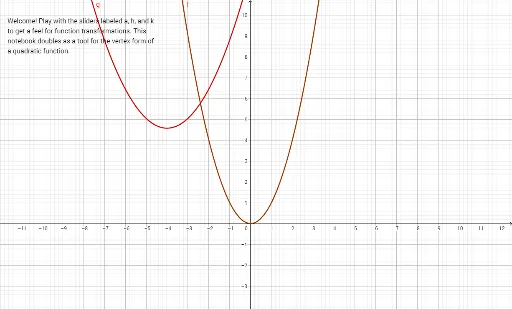
① This example dynamically demonstrates how the vertex form of a quadratic function, f(x)=a(x-h)²+k, changes its graph as parameters a, h, and k are varied, showing the vertex location, opening direction, and width. ② Core mathematical concepts include the vertex form of quadratic functions, the roles of parameters a (vertical stretch/reflection), h (horizontal shift), and k (vertical shift), and transformations of parabolas. ③ Construction highlights: using GeoGebra, the function f is defined with sliders for a, h, and k; a text object text1 displays the current equation; an auxiliary object g (possibly a line or axis) helps visualize the vertex and symmetry. ④ Suitable for middle-to-high school students learning quadratic functions, and useful for teachers as an interactive demonstration or for students to explore parameter effects independently.
GeoGebra Commands & Parameters
f(x) = x^(2)Numeric a(0.47)Numeric h(-4)Numeric k(4.57)g(x) = (a * (x - h)^(2)) + k
AI Drawing Prompt Reference
Draw a quadratic function in vertex form with a=0.47, h=-4, and k=4.57. Start by plotting y=x^2, then modify the graph by changing the parameters a, h, and k to alter the opening direction, vertex position, and width. Make sure to show the current equation and use a line to indicate the vertex and axis of symmetry.
The prompt above was compiled from the original drawing commands and is for reference only.