
Verify Opposite Angles in a Parallelogram and Supplementary Consecutive Angles (1)
Loading the math board and drawing, please wait…
In collections
CCSS IP Math II Unit 5 Lesson 7
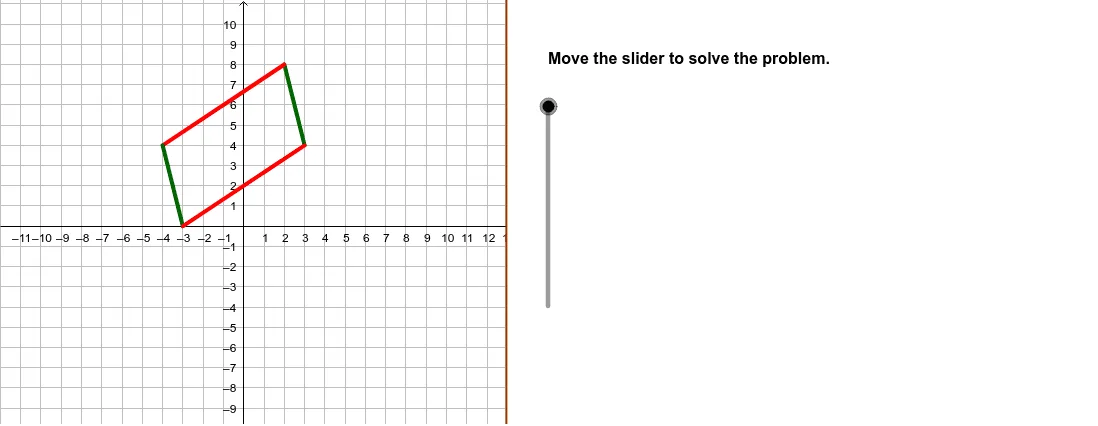
This example uses the parallelogram from Example 1 to demonstrate that opposite angles in a parallelogram are congruent and consecutive angles are supplementary. It involves the mathematical concepts of parallelogram properties and angle relationships. The construction uses GeoGebra commands such as Segment, Line, Polygon, Intersect, and Angle. Suitable for students at the junior high school level and above.
GeoGebra Commands & Parameters
Segment(B, C) → BCLine(A, BC) → lineADSegment(A, B) → ABLine(C, AB) → lineCDPolygon((Edge, y(Corner[1])), Corner[2], Corner[3], (Edge, y(Corner[4]))) → Mask, a, b, c, dIntersect(lineCD, lineAD) → DSegment(A, D) → ADSegment(C, D) → CDAngle(A, B, C) → ABCAngle(B, C, D) → BCDAngle(D, A, B) → DABAngle(C, D, A) → CDALine(A, B) → lineABLine(B, C) → lineBCAngle(A1, A, A2) → Ang1Angle(B, A, A2) → Ang2Angle(B, A, D) → Ang4Angle(A1, A, D) → Ang3Angle(B1, B, C) → Ang8Angle(B1, B, B2) → Ang6Angle(B2, B, A) → Ang5Angle(A, B, C) → Ang7Angle(B, C, D) → Ang9Angle(B, C, C1) → Ang10Angle(C2, C, C1) → Ang12Angle(C2, C, D) → Ang11Angle(C, D, A) → Ang14Angle(D2, D, D1) → Ang15Angle(D1, D, C) → Ang16Angle(D2, D, A) → Ang13Angle(B, C, D) → Ang9aAngle(B, A, D) → Ang4aAngle(D1, D, C) → Ang16aAngle(D2, D, A) → Ang13aAngle(A, B, C) → Ang7aAngle(B, C, C1) → Ang10aAngle(C2, C, D) → Ang11aAngle(C, D, A) → Ang14a
AI Drawing Prompt Reference
Draw a parallelogram ABCD, connect the diagonals AC and BD, and label the four interior angles ∠ABC, ∠BCD, ∠CDA, and ∠DAB to verify that opposite angles are equal and consecutive angles are supplementary. Start by plotting points A, B, C, and D, then draw segments AB, BC, CD, and DA. Next, draw the diagonals AC and BD, and finally measure and label the degree of each interior angle to observe if opposite angles are equal and consecutive angles are supplementary.
The prompt above was compiled from the original drawing commands and is for reference only.