
Velocity Addition I
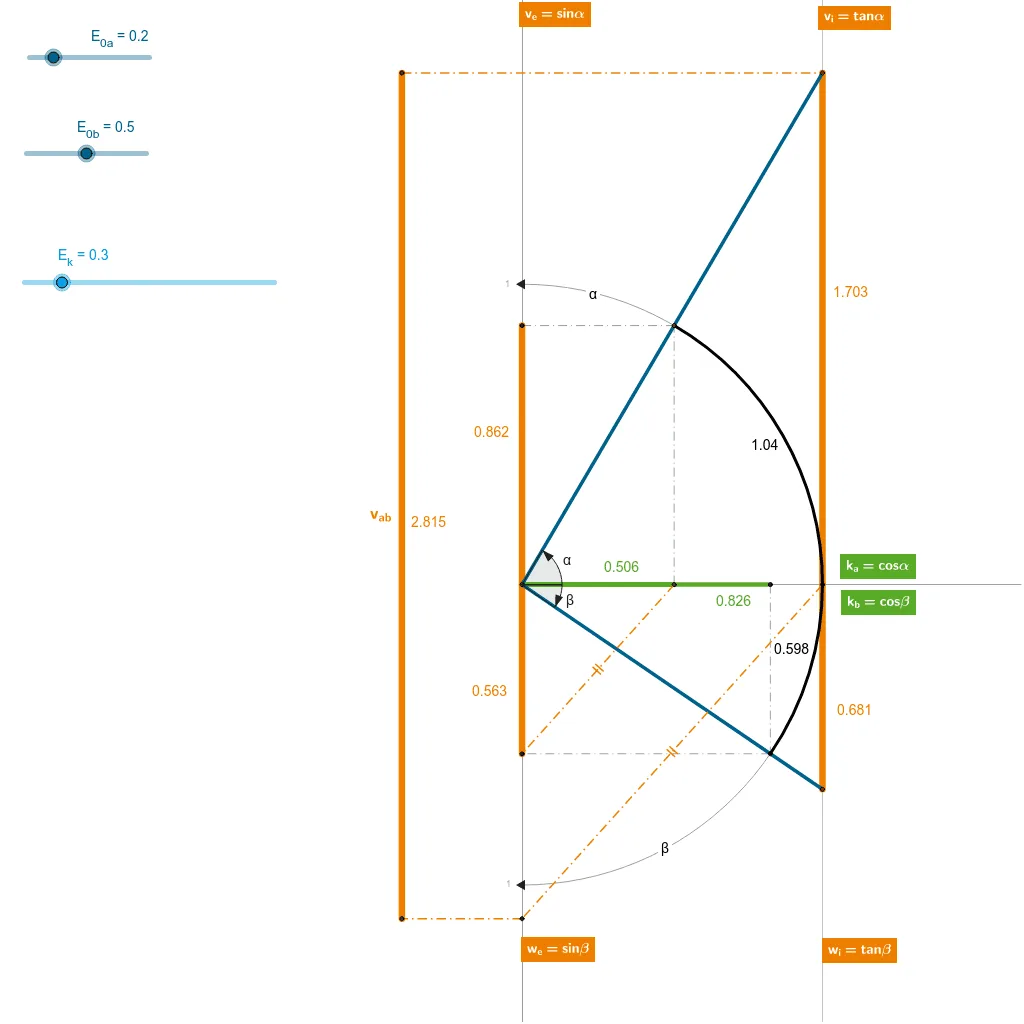
Loading the math board and drawing, please wait…
This example demonstrates the principle of velocity addition, illustrating the resultant velocity by vector addition of two velocities. It involves core mathematical concepts like vectors, trigonometry, and geometric constructions. The construction uses commands such as Point, Segment, CircleArc, Intersect, Ray, OrthogonalLine, Angle, Line, Circle. Suitable for high school physics and mathematics education to understand vector addition and geometric relationships.
GeoGebra Commands & Parameters
Point(yAxis) → RPoint(yAxis) → ASegment(A, S) → iPoint(xAxis) → CPoint(yAxis) → BCircleArc(A, R, B) → cIntersect(c, i) → T,Ray(A, C) → bOrthogonalLine(C, b) → dCircleArc(A, C, T) → ArcAngle(C, A, Rotate[C, alfa, A]) → αOrthogonalLine(T, yAxis) → jOrthogonalLine(T, xAxis) → lIntersect(j, yAxis) → UIntersect(l, xAxis) → VSegment(A, V) → cosinusSegment(A, U) → sinusSegment(U, T) → sSegment(V, T) → tSegment(C, S) → tangensPoint(yAxis) → LPoint(d) → MSegment(A, J) → mIntersect(c, m) → O,OrthogonalLine(O, yAxis) → nOrthogonalLine(O, xAxis) → pIntersect(p, xAxis) → PIntersect(n, yAxis) → QSegment(C, J) → qSegment(A, Q) → rSegment(A, P) → b_1Angle(J, A, V) → βSegment(P, O) → eSegment(O, Q) → fCircleArc(A, O, C) → gSegment(T, S) → aSegment(J, O) → hSegment(V, Q) → kLine(C, k) → a_1Intersect(a_1, yAxis) → FLine(F, xAxis) → c_1Line(S, xAxis) → d_1Point(d_1) → GLine(G, yAxis) → e_1Intersect(e_1, c_1) → HSegment(G, H) → v_1Segment(G, S) → g_1Segment(H, F) → h_1Segment(F, C) → i_1Segment(I, A) → f_1Line(N, yAxis) → j_1Circle(N, Ea / 5) → k_1Circle(Z, Eb / 5) → p_1OrthogonalLine(S, j_1) → l_1Segment(V, Q) → m_1Line(C, m_1) → n_1Intersect(yAxis, n_1) → B_1Intersect(l_1, j_1) → C_1OrthogonalLine(B_1, j_1) → q_1Intersect(j_1, q_1) → D_1Segment(C, B_1) → r_1Segment(B_1, D_1) → s_1Segment(C_1, S) → t_1Segment(C_1, D_1) → v_{ab}