
Mechanical Energy Conservation of a Free Falling Object
Loading the math board and drawing, please wait…
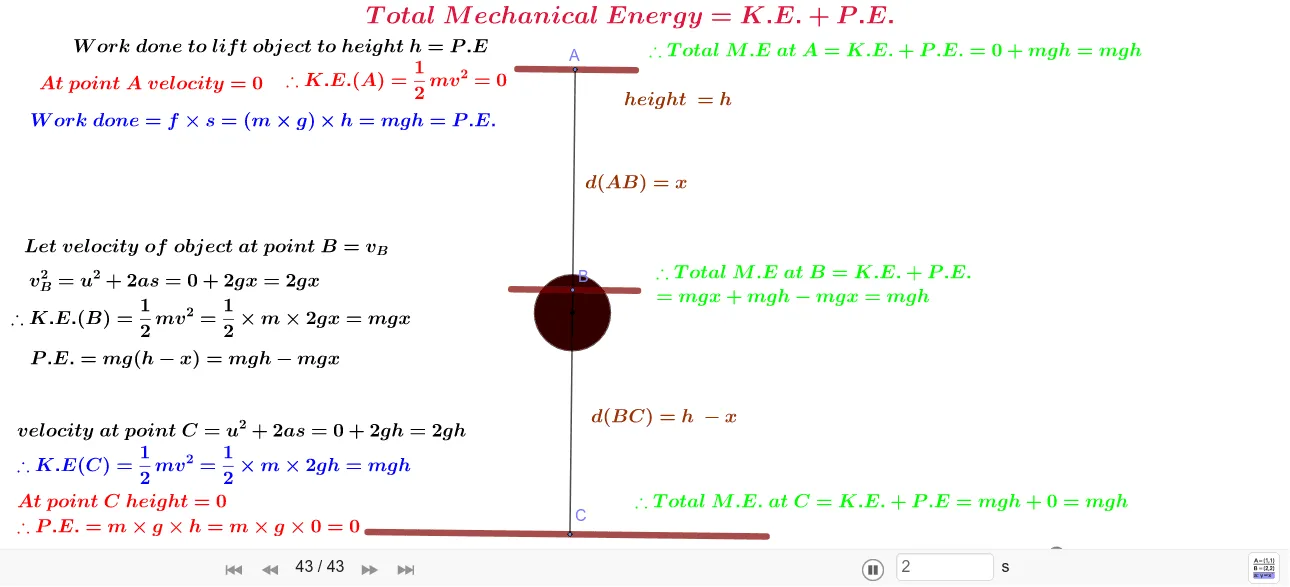
This example demonstrates the conservation of mechanical energy in a freely falling body. Key math concepts include kinetic energy, potential energy, the law of conservation of mechanical energy, and kinematic equations. Construction highlights involve using GeoGebra commands like Segment, Point, OrthogonalLine, and Circle to visualize motion trajectories, velocity vectors, and height changes. Suitable for high school physics and mathematics education to illustrate energy transformation and conservation principles.
GeoGebra Commands & Parameters
Segment(A_1, B_1) → fPoint(f) → COrthogonalLine(C, f) → gPoint(g) → ASegment(A, C) → hPoint(h) → DPoint(h) → BOrthogonalLine(A, h) → iOrthogonalLine(B, h) → jPoint(i) → GPoint(i) → HSegment(G, H) → kPoint(j) → IPoint(j) → JSegment(I, J) → lCircle(D, 0.5) → c
AI Drawing Prompt Reference
Create a diagram illustrating the conservation of mechanical energy in a free-falling object, showing the transformation between kinetic and potential energy. Include the motion trajectory, velocity vectors, and use line segments and orthogonal lines to represent them. Mark height changes clearly. Start with a base line segment, then create points and orthogonal lines along it to form the motion path. Add a circle to represent the object and connect key points with line segments to visualize the energy conservation principles.
The prompt above was compiled from the original drawing commands and is for reference only.