
Velázquez's Las Meninas: Geometric Perspective and Orthogonal Line Construction
Loading the math board and drawing, please wait…
In collections
geometriadinamica.es
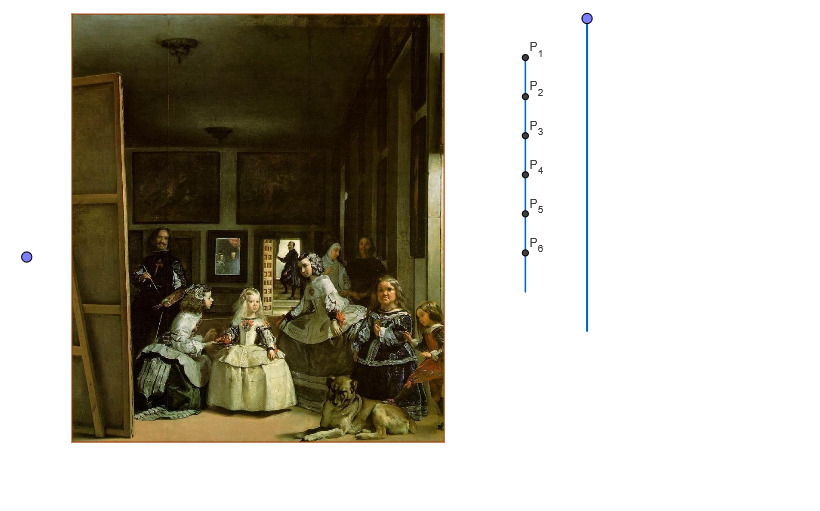
① This example uses Velázquez's famous painting 'Las Meninas' as a backdrop to demonstrate how to construct orthogonal lines, perpendicular feet, and perspective auxiliary lines within the artwork using GeoGebra's geometric tools, thereby analyzing the geometric relationships in the composition. ② Core mathematical concepts include orthogonal lines (perpendiculars), points, segments, circles, polygons, mirror transformations, and homothety (dilation) based on proportional scaling, involving fundamental principles of analytic geometry and geometric construction. ③ Construction highlights: From the construction summary, commands such as OrthogonalLine, Point, Segment, If, Dilate, Circle, Intersect, Polygon, Line, and Mirror are used, along with numerous auxiliary points (e.g., A_1, B_1, P_0 to P_8) and lines (e.g., d, a, b, t_1, t_2) to build a complex network of geometric relations. ④ Suitable for high school or early college geometry courses, as well as interdisciplinary teaching of art and mathematics, helping students understand perspective principles in painting and geometric construction methods, enhancing spatial visualization and geometric drawing skills.
GeoGebra Commands & Parameters
OrthogonalLine(B, xAxis) → aPoint(a) → CSegment(B, C) → bPoint(b) → M_1If(pas > 4 ∧ pas < 7, 0, -1) → t_5OrthogonalLine(B_5, b) → d_5OrthogonalLine(A_5, b) → p_1Point(d_5) → W_2OrthogonalLine(W_2, p_1) → f_3Point(f_3) → Z_2Point(f_3) → Y_2Segment(Y_2, Z_2) → g_3Point(g_3) → C_3OrthogonalLine(C_3, f_3) → h_3Point(d_5) → R_2Point(p_1) → O_2Segment(O_2, R_2) → r_2Point(r_2) → S_2OrthogonalLine(S_2, p_1) → s_2If(pas > 0 ∧ pas < 7, 0, -1) → t_1OrthogonalLine(A, b) → dIf(pas > 1 ∧ pas < 7, 0, -1) → t_2If(pas > 2 ∧ pas < 7, 0, -1) → t_3If(pas > 3 ∧ pas < 7, 0, -1) → t_4If(pas > 5 ∧ pas < 7, 0, -1) → t_6Point(d) → DOrthogonalLine(A, b) → eDilate(D, pr, A) → ECircle(A, E) → fOrthogonalLine(A, e) → gIntersect(f, g, 2) → FOrthogonalLine(F, g) → hOrthogonalLine(D, e) → iIntersect(h, i) → GSegment(P_1, P_7) → cPolygon(A, F, G, D) → P, a_1, f_1, g_1, d_1Segment(B_1, G) → jPoint(j) → HSegment(H, D) → kPoint(k) → IOrthogonalLine(I, b) → lIntersect(g_1, l) → JSegment(I, J) → mLine(B_2, b) → nPoint(n) → KPoint(g_1) → LIntersect(f_1, j) → NPoint(g_1) → OIntersect(f_1, j) → QIntersect(f_1, j) → RIntersect(f_1, j) → TIntersect(f_1, j) → UPoint(f_1) → VPoint(f_1) → WPoint(f_1) → YSegment(K, L) → pSegment(K, O) → qSegment(K, W) → rSegment(K, V) → sOrthogonalLine(B_3, b) → tPoint(t) → SPoint(t) → ZPoint(t) → C_1Point(t) → D_1OrthogonalLine(S, t) → b_1OrthogonalLine(Z, t) → c_1OrthogonalLine(C_1, t) → e_1Intersect(r, b_1) → E_1Intersect(b_1, q) → F_1Intersect(b_1, p) → G_1Intersect(b_1, l) → H_1Intersect(c_1, r) → I_1Intersect(c_1, q) → J_1Intersect(c_1, p) → K_1Intersect(c_1, l) → L_1Intersect(e_1, l) → N_1Intersect(e_1, p) → O_1Intersect(e_1, q) → Q_1Intersect(e_1, r) → R_1OrthogonalLine(D_1, t) → h_1Intersect(l, h_1) → S_1Intersect(h_1, p) → T_1Intersect(h_1, q) → U_1Polygon(H_1, G_1, K_1, L_1) → V_1, h_2, g_2, k_1, l_1Polygon(F_1, E_1, I_1, J_1) → W_1, f_2, e_2, i_1, j_1Polygon(N_1, O_1, T_1, S_1) → Y_1, n_1, o_1, t_7, s_1Polygon(Q_1, R_1, W, U_1) → Z_1, q_1, r_1, w, u_1Line(B_4, b) → m_1Point(m_1) → C_2Segment(K, C_2) → a_2Mirror(K, n) → K'Mirror(L, n) → L'Mirror(K, n) → K'_1Mirror(C_2, n) → C_2'Line(E_2, m_1) → d_2Point(d_2) → F_2Segment(E_2, F_2) → i_2Point(m_1) → G_2Segment(K, G_2) → j_2Point(m_1) → H_2Segment(K, H_2) → k_2Mirror(K, n) → K'_2Mirror(G_2, n) → G_2'Segment(K'_2, G_2') → l_2Mirror(K, n) → K'_3Mirror(H_2, n) → H_2'Segment(K'_3, H_2') → m_2Point(i_2) → I_2OrthogonalLine(I_2, b) → n_2Intersect(l_2, n_2) → J_2Intersect(n_2, j_2) → K_2OrthogonalLine(J_2, n_2) → p_2OrthogonalLine(K_2, n_2) → q_2Intersect(m_2, p_2) → L_2Intersect(k_2, q_2) → M_2Polygon(L_2, J_2, K_2, M_2) → Q_2, l_3, j_3, k_3, m_3Point(d_5) → D_2Point(d_5) → N_2Line(D_2, b) → b_2Line(N_2, b) → c_2Point(b_2) → T_2Point(c_2) → U_2Intersect(s_2, h_3) → V_2Segment(V_2, T_2) → a_3Segment(V_2, U_2) → b_3OrthogonalLine(U_2, a_3) → c_3Mirror(V_2, c_3) → V_2'Mirror(U_2, c_3) → U_2'Segment(V_2', U_2') → d_3Segment(V_2', T_2) → e_3Dilate(A, fi, D) → E_3OrthogonalLine(B_6, b) → i_3
AI Drawing Prompt Reference
Draw a geometric view of Velázquez's painting 'Las Meninas', including orthogonal lines, perpendicular feet, and perspective auxiliary lines, to analyze the geometric relationships in the composition. The painting features multiple points, line segments, circles, polygons, and other geometric shapes, constructed using mirror transformations and homothety based on proportional scaling, showcasing the painting's geometric structure and perspective principles.
The prompt above was compiled from the original drawing commands and is for reference only.