
Leonardo's Last Supper Geometric Construction
Loading the math board and drawing, please wait…
In collections
geometriadinamica.es
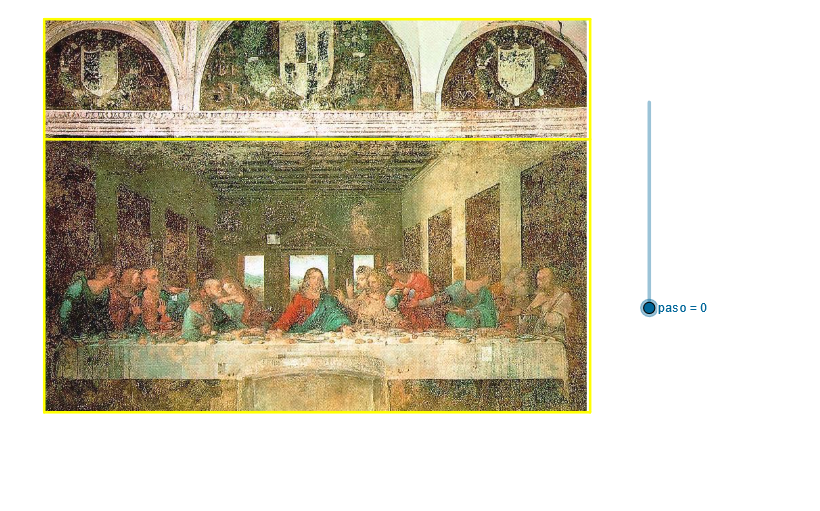
This example dynamically demonstrates geometric constructions inspired by Leonardo da Vinci's 'The Last Supper', focusing on composition and symmetry. It involves core math concepts like geometric construction, coordinate geometry, similarity transformations, and fractal geometry. GeoGebra commands and objects used include Line, OrthogonalLine, Point, Dilate, Circle, Intersect, Polygon, Midpoint, Segment, and CircleArc. Suitable for high school students and enthusiasts in mathematical art and geometric constructions.
GeoGebra Commands & Parameters
Line(H1, H2) → aOrthogonalLine(A, a) → cLine(A, a) → bPoint(b) → BOrthogonalLine(B, b) → fDilate(B, pr, A) → DilCircle(A, Dil) → dIntersect(d, c) → D5, COrthogonalLine(C, c) → eIntersect(f, e) → DIf(paso > 0 ∧ paso < 7, 1, 0) → t_1If(paso > 1 ∧ paso < 7, 1, 0) → t_2If(paso > 2 ∧ paso < 7, 1, 0) → t_3If(paso > 3 ∧ paso < 7, 1, 0) → t_4If(paso > 4 ∧ paso < 7, 1, 0) → t_5If(paso > 5 ∧ paso < 7, 1, 0) → t_6Polygon(A, B, D, C) → P, a_1, b_1, d_1, c_1Point(b_1) → W_2Midpoint(A, B) → FCircle(A, F) → gCircle(B, F) → hIntersect(g, c_1) → E,Intersect(h, b_1) → G,Segment(E, G) → iOrthogonalLine(B_1, a_1) → jPoint(j) → HCircleArc(A, H, E) → kCircleArc(B, G, H) → pIntersect(j, i) → ISegment(H, I) → lOrthogonalLine(B_2, a_1) → mPoint(m) → KMidpoint(A, K) → LMidpoint(K, B) → MOrthogonalLine(M, a_1) → nOrthogonalLine(L, a_1) → qIntersect(i, q) → NIntersect(n, i) → OSegment(N, L) → rSegment(O, M) → sSegment(K, E) → f_1Segment(K, G) → g_1Intersect(m, i) → QSegment(Q, A) → tSegment(Q, B) → e_1Circle(N, N1) → h_1Circle(N, N2) → k_1Circle(N, N4) → q_1Circle(N, N5) → r_1OrthogonalLine(B_3, a_1) → i_1Point(i_1) → SPoint(i_1) → TPoint(i_1) → UPoint(i_1) → VPoint(i_1) → WPoint(i_1) → YOrthogonalLine(G, i_1) → j_1Point(j_1) → ZPoint(j_1) → C_1Point(j_1) → D_1Point(j_1) → E_1Point(j_1) → F_1Circle(O, F_1) → p_1Circle(O, E_1) → s_1Circle(O, D_1) → c_2Circle(O, C_1) → d_2Circle(O, Z) → e_2Circle(L, V) → f_2Circle(L, U) → g_2Circle(L, T) → h_2Circle(L, S) → k_2Circle(L, Y) → p_2Intersect(i_1, j_1) → H_1Circle(L, H_1) → q_2Intersect(g_2, a_1) → I_1, J_1Intersect(f_2, a_1) → K_1, L_1Intersect(h_2, a_1) → M_1,Intersect(k_2, a_1) → N_1,Intersect(p_2, a_1) → O_1,Intersect(q_2, a_1) → P_1,Intersect(p_1, s) → Q_1,Intersect(s_1, s) → R_1,Intersect(c_2, s) → S_1,Intersect(d_2, s) → T_1,Intersect(e_2, s) → U_1,Segment(Z, L_1) → l_1Segment(C_1, J_1) → m_1Segment(M_1, D_1) → n_1Segment(E_1, N_1) → a_2Segment(O_1, F_1) → b_2Segment(Q_1, Y) → i_2Segment(S, R_1) → j_2Segment(S_1, T) → l_2Segment(U, T_1) → m_2Segment(V, U_1) → n_2OrthogonalLine(B_4, a_1) → r_2Line(W_1, r_2) → s_2Line(Y_1, r_2) → a_3Line(Z_1, r_2) → b_3Point(s_2) → C_2Point(s_2) → D_2Point(r_2) → E_2Point(r_2) → F_2Point(a_3) → G_2Point(a_3) → H_2Point(b_3) → I_2Point(b_3) → J_2Polygon(C_2, I_2, J_2, D_2) → P_2, c_3, i_3, j_3, d_3Polygon(E_2, G_2, H_2, F_2) → Q_2, e_3, g_3, h_3, f_3Line(B_5, a_1) → k_3Point(k_3) → K_2Segment(K_2, E) → l_3Segment(K_2, N) → m_3Segment(K_2, N1) → n_3Segment(K_2, N2) → p_3Segment(K_2, D_1) → q_3Segment(K_2, N4) → r_3Segment(K_2, N5) → s_3Segment(K_2, O) → a_4Segment(K_2, G) → b_4Line(B_6, a_1) → c_4Point(c_4) → L_2Point(c_4) → M_2Point(c_4) → N_2Point(c_4) → O_2Circle(M_2, ra) → d_4Circle(L_2, ra) → e_4Circle(N_2, ra) → f_4Circle(O_2, ra) → g_4Midpoint(N, L) → R_2OrthogonalLine(R_2, c_1) → h_4Intersect(c_1, h_4) → S_2Intersect(b_1, h_4) → T_2Segment(S_2, T_2) → i_4Point(c_1) → U_2Segment(K_2, U_2) → j_4Segment(K_2, W_2) → k_4
AI Drawing Prompt Reference
Create a geometric composition inspired by Leonardo da Vinci's The Last Supper. Start with a horizontal baseline and a vanishing point above it. Draw radiating lines from the vanishing point to the two bottom corners of the canvas to establish perspective framework. Use the two bottom corners as endpoints to draw arcs intersecting at a point above, forming a trapezoidal figure layout area. Within the trapezoid, draw perpendicular and parallel lines to create a grid structure, then use key intersection points as centers to draw multiple concentric circles and circular arcs, creating radially symmetrical decorative patterns. The overall composition emphasizes the contrast between horizontal-vertical lines and curved arcs, reflecting the perspective principles and geometric beauty of Renaissance painting.
The prompt above was compiled from the original drawing commands and is for reference only.