
Geometric Construction Analysis of Titian's 'Venus and the Organist'
Loading the math board and drawing, please wait…
In collections
geometriadinamica.es
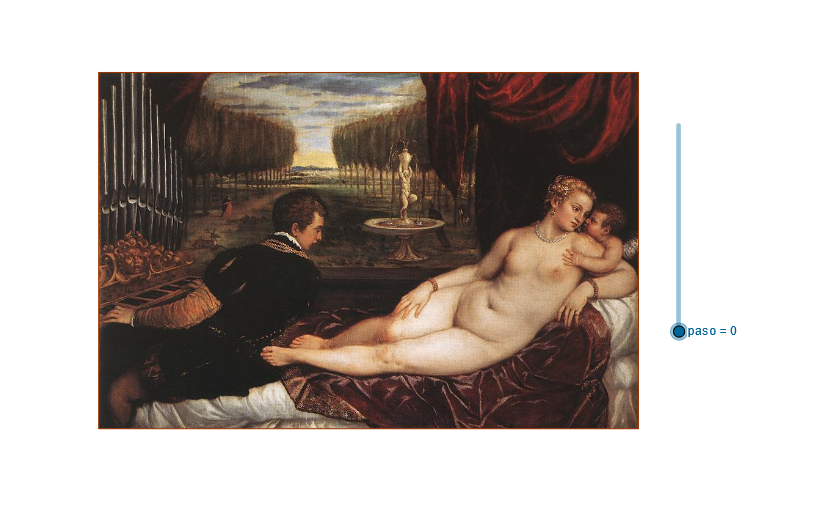
① This GeoGebra example uses Titian's famous painting 'Venus and the Organist' as a backdrop to construct a series of geometric figures, demonstrating how geometric elements can simulate or analyze the composition of the artwork. ② Core mathematical concepts involve geometric transformations (dilation, orthogonality), intersections of circles and lines, construction of polygons and circular arcs, as well as geometric probability distributions and confidence intervals (as indicated by original tags, though the actual construction is primarily geometric). ③ Construction highlights: from the summary, commands such as If, Line, OrthogonalLine, Point, Dilate, Circle, Intersect, Polygon, Segment, and CircleArc are used, creating multiple points (A, B, C, D, etc.), lines, circles, polygons, and arcs, with dilations and orthogonal lines to build complex shapes, possibly to outline figures or musical instruments in the painting. ④ Suitable for high school or college geometry instruction, this serves as an interdisciplinary case combining art and mathematics, useful for teaching geometric construction, transformations, and graphical analysis, as well as for visualizing statistical distributions.
GeoGebra Commands & Parameters
If(paso > 0 ∧ paso < 7, 1, 0) → t_1If(paso > 1 ∧ paso < 7, 1, 0) → t_2If(paso > 2 ∧ paso < 7, 1, 0) → t_3If(paso > 3 ∧ paso < 7, 1, 0) → t_4If(paso > 4 ∧ paso < 7, 1, 0) → t_5If(paso > 5 ∧ paso < 7, 1, 0) → t_6Line(H1, H2) → aLine(A, a) → bOrthogonalLine(A, a) → cPoint(b) → BDilate(B, pr, A) → DilCircle(A, Dil) → dIntersect(d, c) → D5, COrthogonalLine(C, c) → eOrthogonalLine(B, b) → fIntersect(f, e) → DPolygon(A, B, D, C) → P, a_1, b_1, d_1, c_1OrthogonalLine(B_1, c_1) → gOrthogonalLine(B_1, d_1) → hOrthogonalLine(B_2, a_1) → iOrthogonalLine(V_4, i) → jOrthogonalLine(V_6, i) → kOrthogonalLine(B_3, b_1) → lOrthogonalLine(H_4, l) → mOrthogonalLine(H_6, l) → nIntersect(j, i) → EIntersect(k, i) → FIntersect(l, n) → GIntersect(m, l) → HIntersect(m, a_1) → IIntersect(n, a_1) → JIntersect(j, b_1) → KIntersect(k, b_1) → LSegment(F, L) → pSegment(K, E) → qSegment(G, J) → rSegment(I, H) → sSegment(B_4, A) → tIntersect(t, b_1) → MSegment(E, B_5) → e_1OrthogonalLine(B_6, b_1) → f_1Intersect(f_1, s) → NIntersect(r, t) → OCircle(N, O) → g_1Intersect(g_1, d_1) → Q, RIntersect(g_1, d_1, 2) → SCircleArc(N, S, Q) → h_1Intersect(b_1, e_1) → TSegment(T, E) → i_1Segment(M, A) → j_1Segment(H_9, H_0) → k_1Segment(V_9, V_0) → l_1
AI Drawing Prompt Reference
Draw a series of geometric shapes on the background of Titian's 'Venus and the Organist', including points A, B, C, D, etc., using lines, circles, polygons, and arcs to construct complex shapes. Start by drawing line AB, then construct orthogonal lines and circles, and use intersection points to determine new points, gradually building polygons and arcs to form the outlines of instruments and figures in the painting.
The prompt above was compiled from the original drawing commands and is for reference only.