
Vectors and Matrices Revised: Visualizing Linear Transformations
Loading the math board and drawing, please wait…
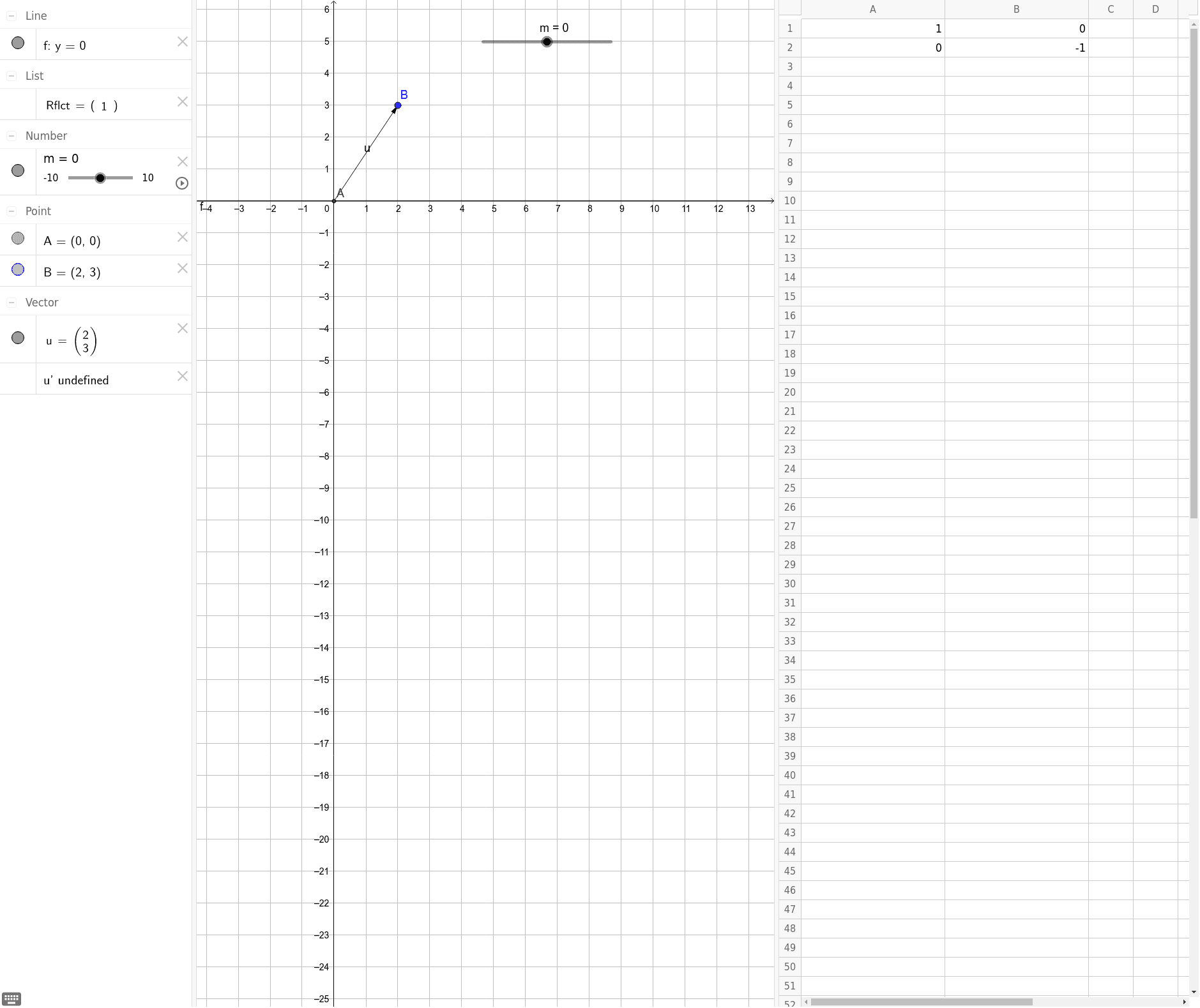
This example demonstrates how matrix multiplication applies linear transformations to vectors and geometric figures in the plane, allowing observation of the correspondence between original and transformed points, vectors, and tangent lines. Core mathematical concepts include vector operations, matrix multiplication, linear transformations, reflection (mirror symmetry), and the behavior of tangent lines and incircles under transformation. Construction highlights: using GeoGebra commands such as Intersect to find intersection points, Vector to construct vectors, ApplyMatrix to apply a matrix to objects, and Rflct for reflection; objects include points A and B, vector u, matrix m, function f, and transformed points A1, B1, A2, B2, and vector u'. Suitable for high school to undergraduate courses in linear algebra and analytic geometry, as well as calculus demonstrations of tangent concepts, providing an intuitive dynamic view of how matrix transformations affect geometric objects.
GeoGebra Commands & Parameters
Intersect(xAxis, yAxis) → AVector(A, B) → uApplyMatrix(Rflct, u) → u'
AI Drawing Prompt Reference
Draw a Cartesian coordinate system, then select two points A and B to form vector u. Reflect vector u to get vector u'. Observe the relationship and positions of vector u and vector u' in the coordinate system.
The prompt above was compiled from the original drawing commands and is for reference only.