
Vector Transformation and Plane
Loading the math board and drawing, please wait…
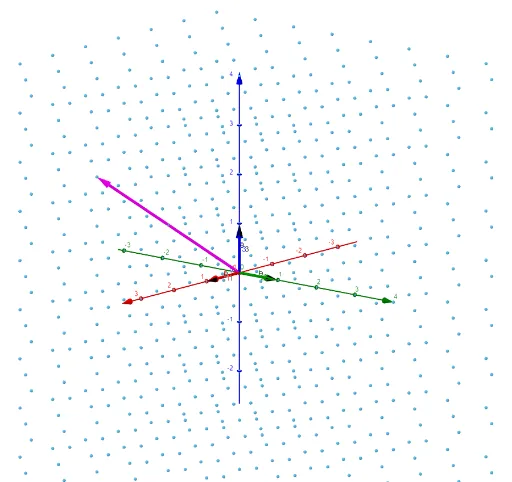
This example demonstrates the use of vector transformations and planes to construct geometric shapes. Key mathematical concepts include vectors, coordinates, and transformations. Using commands like ApplyMatrix and OrthogonalPlane, users can understand how vectors transform in a two-dimensional space and their impact on geometric shapes. Suitable for high school mathematics education and learning.
GeoGebra Commands & Parameters
ApplyMatrix(M, e_{1}) → t_{1}ApplyMatrix(M, e_{2}) → t_{2}ApplyMatrix(M, e_{3}) → t_{3}OrthogonalPlane((0, 0, 0), Vector[t_{1} ⊗ t_{2}]) → dOrthogonalPlane((0, 0, 0), Vector[t_{1} ⊗ t_{3}]) → eOrthogonalPlane((0, 0, 0), Vector[t_{2} ⊗ t_{3}]) → fOrthogonalPlane(P, Vector[u ⊗ v]) → aPointIn(a) → BApplyMatrix(M, B) → B'Sequence(Sequence[(n - (2 * w) + t, w, t), w, -4, 4, 1], t, -4, 4, 1) → m1ApplyMatrix(M, m1) → m1'Sequence(Sequence[Sequence[(x_{1}, x_{2}, x_{3}), x_{1}, -4, 4, 1], x_{2}, -4, 4, 1], x_{3}, -4, 4, 1) → l1ApplyMatrix(M, l1) → l1'ApplyMatrix(M, C) → C'Point((0, 0, 0), t_{1}) → DTranslate(t_{1}, D) → cPoint((0, 0, 0), t_{2}) → ETranslate(Vector[(-t_{2})], (4 * D)) → gTranslate(Vector[(-t_{2})], (4 * D) - E) → hTranslate(t_{1}, (2 * D)) → iTranslate(t_{1}, (3 * D)) → jSequence((4 - t, -2 - t, t), t, -4, 4, 0.5) → l2ApplyMatrix(M, l2) → l2'