
Vector Functions of Constant Length
Loading the math board and drawing, please wait…
In collections
surface 3D /3D-Oberflächen 1
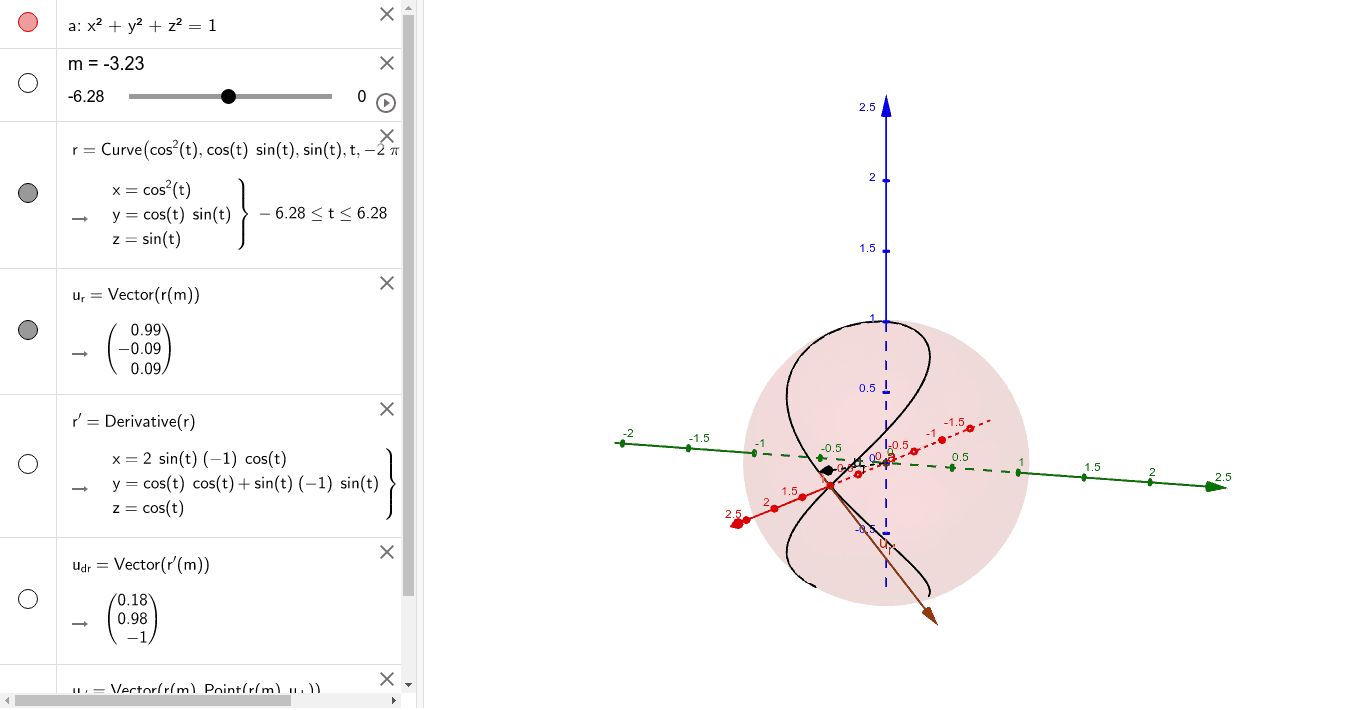
This example demonstrates the graph and properties of vector functions of constant length. The core mathematical concepts involved include vector functions, derivatives, and tangent lines. The construction uses GeoGebra commands and objects such as CurveCartesian, Vector, Derivative, and a, m, r, u_r, r', u_{dr}, u_{r'} to build and visualize the vector function and its derivative. Suitable for university calculus or vector calculus courses.
GeoGebra Commands & Parameters
CurveCartesian(cos(t)^(2), (cos(t) * sin(t)), sin(t), t, (-2 * π), (2 * π)) → rVector(r(m)) → u_rDerivative(r) → r'Vector(r'(m)) → u_{dr}Vector(r(m), Point[r(m), u_{dr}]) → u_{r'}
AI Drawing Prompt Reference
Draw the graph of a vector function with constant length, showing its curve and properties including the vector function itself, its derivative, and tangent lines. First, plot a parametric curve, then draw a unit vector pointing from the origin to a point on the curve. Next, find the derivative of the vector function and draw its unit vector. Finally, connect the point on the curve to the endpoint of the derivative's unit vector to form a new vector.
The prompt above was compiled from the original drawing commands and is for reference only.