
Derivative of Vector-Valued Function: Geometric Meaning of Parametric Curve Tang
Loading the math board and drawing, please wait…
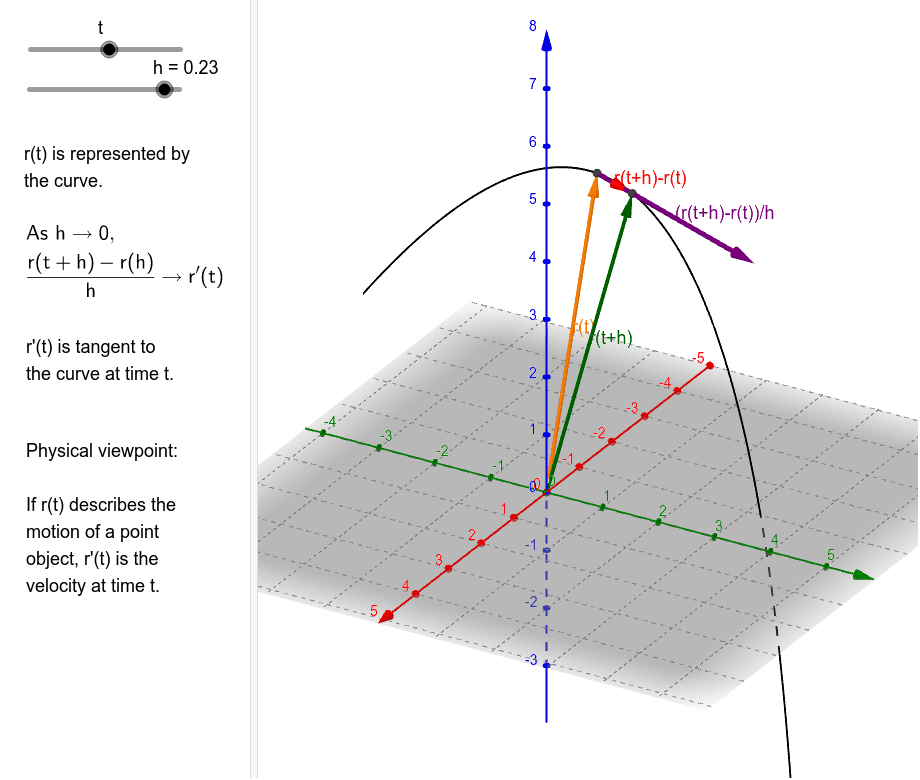
This example demonstrates the geometric interpretation of the derivative of a vector-valued function with respect to its parameter. Using the CurveCartesian command to construct parametric curves, Vector commands to represent position and velocity vectors, Tangent to draw tangents, and Translate for vector translation. The core mathematical concept is that the derivative of a vector-valued function (velocity vector) indicates the tangent direction of the curve, while its magnitude reflects the rate of change at that point. The construction uses a slider parameter t to control point P moving along the curve, simultaneously displaying the tangent and velocity vector v at P, intuitively showing the instantaneous rate of change meaning of derivatives. Suitable for high school mathematics extension courses or university calculus courses covering parametric curves and vector analysis.
GeoGebra Commands & Parameters
CurveCartesian(t^(2) - 3, (3 * t) - 1, 4 - (2 * t^(2)), t, -4, 3) → aVector(P) → uVector(Q) → vVector(P, Q) → wTangent(P, a) → bTranslate(P, c) → P'Vector(P, P') → dVector(((2 * t), 3, ((-4) * t))) → eTranslate(P, e) → P'_1Vector(P, P'_1) → f
AI Drawing Prompt Reference
Draw a parametric curve where point P moves along the curve as the parameter t changes. Mark point P and draw the tangent line at P. Also show a velocity vector v that aligns with the tangent. Include another point Q to form a vector w. The overall graph illustrates the geometric meaning of parametric curves, including tangents, velocity vectors, and position vectors.
The prompt above was compiled from the original drawing commands and is for reference only.