
Vector Component Addition: Combining Component Vectors
Loading the math board and drawing, please wait…
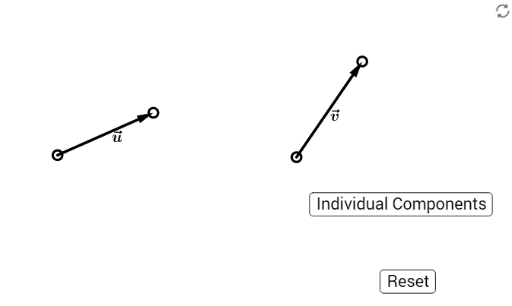
① This GeoGebra example dynamically demonstrates vector component addition, showing how two component vectors (e.g., u and v) combine into a resultant vector w via tip-to-tail or parallelogram methods, with explicit coordinate component sums (a', b'). ② Core mathematical concepts include vector addition, vector decomposition and composition, coordinate representation, translation transformations, and extensions to parametric curves (e.g., helical curves on a cylinder) and arithmetic mean. ③ Construction highlights: uses Vector command to create vectors u, v, w; Segment for auxiliary lines; Point for key points (A, B, C, D, etc.); Translate to shift vectors for tip-to-tail visualization; sliders (button1, button2, button3) control parameters t and m to adjust vector magnitudes and directions; parametric curves f and g are generated, and a Cylinder object is included to show 3D applications. ④ Suitable for high school to early college mathematics, especially for analytic geometry, introductory linear algebra, and physics force composition, as well as exploring intersections between vector addition, parametric curves, and solid geometry.
GeoGebra Commands & Parameters
Vector(A, B) → uVector(C_1, D_1) → vSegment(C_1, B) → fPoint(f, t) → CTranslate(C, v) → DVector(C, D) → wSegment(A, F) → a'Segment(F, B) → b'Point(a', t - 1) → GPoint(b', t - 2) → HSegment(A, G) → gSegment(F, H) → hSegment(C, E) → iPoint(i, t - 1) → ISegment(I, C) → jSegment(E, D) → kPoint(k, t - 2) → JSegment(E, J) → lSegment(A, D) → mPoint(m, s) → KSegment(A, L) → nPoint(n, s - 1) → MSegment(L, D) → pPoint(p, s - 2) → NVector(A, K) → aSegment(M, A) → qSegment(L, N) → r
AI Drawing Prompt Reference
Create a diagram showing vector addition: two component vectors originate from a common point, one horizontal and one slanted, then translate one vector so its tail meets the other's head, forming a resultant vector. Use auxiliary segments and points to mark coordinate components, and include sliders to adjust vector magnitudes and directions. Additionally, generate a parametric curve and a cylinder in the background to illustrate the application of vector addition in 3D space.
The prompt above was compiled from the original drawing commands and is for reference only.