
Using Cylinders to Show Volume of Revolution by Mark Willis
Loading the math board and drawing, please wait…
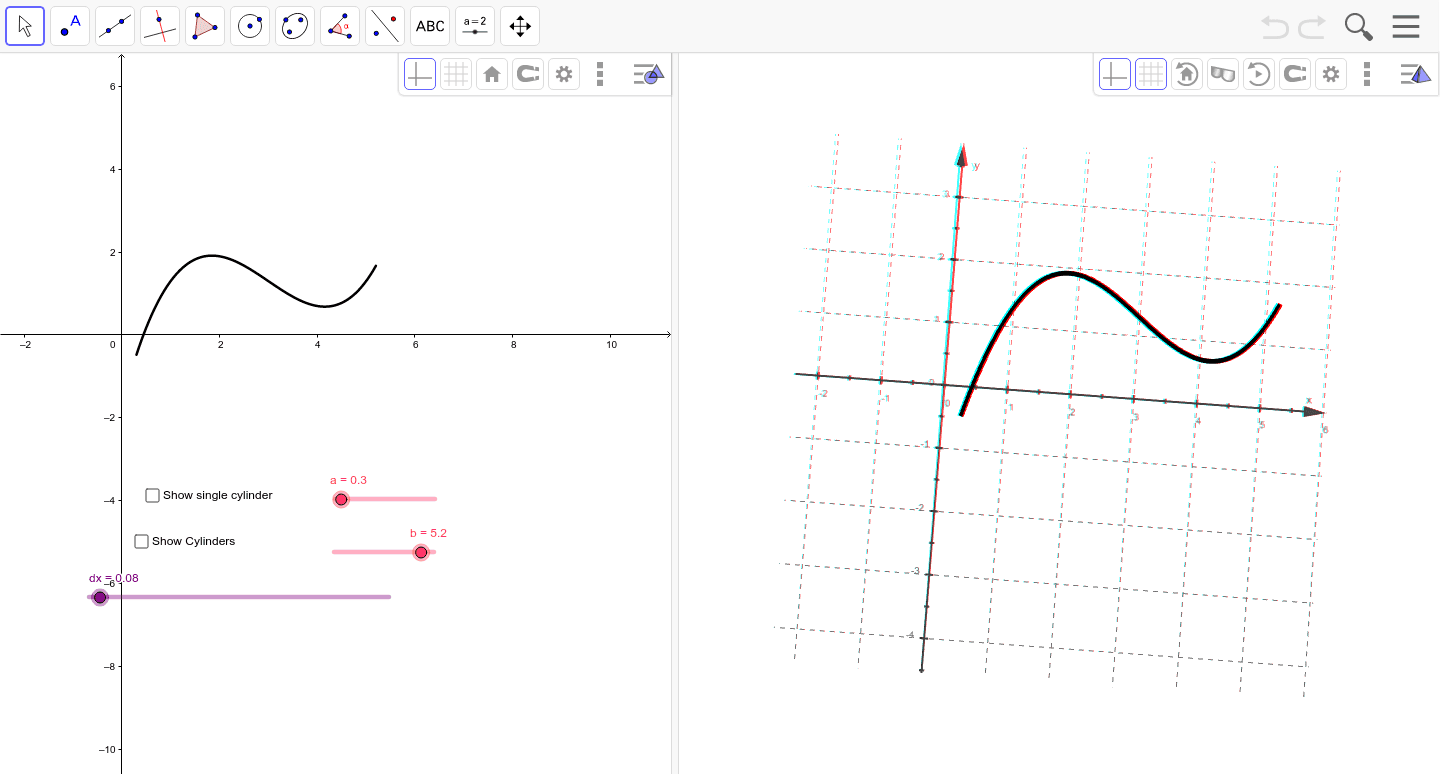
This example dynamically demonstrates how cylinders can be used to build up the volume of a solid of revolution, visually illustrating the concept of integration. Key math concepts include volume of revolution, integration, function graphs, and geometric transformations. Construction highlights involve GeoGebra commands like Function, Div, and Sequence, along with objects such as a (interval start), b (interval end), r (cylinder radius), x_0 (rotation axis), dx (step size), D (integration interval), f (rotating function), E (accumulated volume), r_1 (auxiliary circle radius), singleCylinder (individual cylinder), c (cylinder collection), e (auxiliary element), nsteps (segment count), and cylinders (cylinder objects). Suitable for high school and above students to understand volume calculations in calculus, or for classroom demonstrations.
GeoGebra Commands & Parameters
Function((((1 / 5 * (x - 1)) * (x - 3)) * (x - 5)) + 1.3, a, b) → fDiv(b - a, dx) → nstepsSequence({QuadricSide[Cylinder[(a + (dx * k), 0), (a + (dx * (k + 1)), 0), f(a + (dx * k))]], Top[Cylinder[(a + (dx * k), 0), (a + (dx * (k + 1)), 0), f(a + (dx * k))]], Bottom[Cylinder[(a + (dx * k), 0), (a + (dx * (k + 1)), 0), f(a + (dx * k))]]}, k, a, (b - a) / dx - 1) → cylinders