
Unwrapping a Cylinder: REVAMPED! by jcswanepoel
Loading the math board and drawing, please wait…
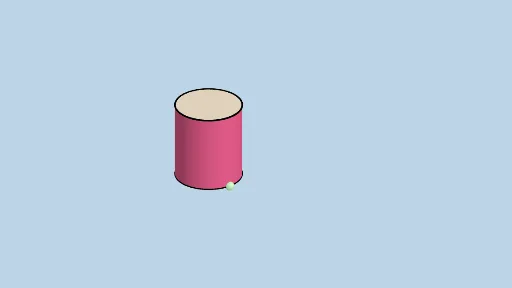
① This example demonstrates how to unfold the surface of a 3D cylinder into a 2D plane, showing the dynamic correspondence of points, lines, and faces during the process. ② Core mathematical concepts include solid geometry (cylinder, net, surface-to-plane mapping), linear programming, quadratic functions, and combinatorial path/covering problems. ③ Construction highlights: using GeoGebra commands such as Cylinder, Line, Intersect, Sphere, Plane, Rotate, Dilate, Vector, Translate, Polygon, Segment, CircleArc, Angle, CurveCartesian, Surface, Midpoint, and Mirror to build the cylinder, auxiliary lines, unfolded polygons and curves, with interactive sliders or dynamic objects. ④ Suitable for high school and above, ideal for teaching solid geometry, enhancing spatial visualization, and exploring mathematical modeling and visualization.
GeoGebra Commands & Parameters
Cylinder(A, C, r) → a, c, d, bLine(D, E) → fIntersect(f, d, 1) → FSphere(F, r) → eIntersect(f, e) → G, HPlane(G, F, C) → gRotate(C, If[0 < i ≤ 1, (i * π / 2), π / 2], D, g) → C'Rotate(d, If[0 < i ≤ 1, (i * π / 2), π / 2], D, g) → d'Rotate(dd, If[0 < i ≤ 1, (i * π / 2), π / 2], D, g) → dd'Dilate(C, If[1 < i ≤ 2, 2 - i, 0], I) → C'_1Dilate(C, If[1 < i ≤ 2, 2 - i, 0], J) → C'_2Vector(C, C'_1) → uVector(C, C'_2) → vTranslate(dd, u) → dd'_1Translate(dd, v) → dd'_2Translate(K, u) → K'Translate(K, v) → K'_1Rotate(K', If[1 < i ≤ 2, ((i - 1) * π), π], C'_1) → K''Rotate(K'_1, If[1 < i ≤ 2, ((-(i - 1)) * π), (-π)], C'_2) → LTranslate(D, u) → D'Translate(D, v) → D'_1Polygon(D', D'_1, N, M) → poly1, d'_1, d'_2, n, mSegment(K'', Q) → jCircleArc(P, Q, M) → kSegment(L, S) → lCircleArc(R, N, S) → pCircleArc(C'_2, D'_1, L) → qCircleArc(C'_1, K'', D') → sPlane(T, A, B) → oRotate(C', If[2 < i ≤ 3, ((i - 2) * π / 2), π / 2], E, g) → C''Rotate(poly1, If[2 < i ≤ 3, ((i - 2) * π / 2), π / 2], E, g) → poly1'Rotate(d', If[2 < i ≤ 3, ((i - 2) * π / 2), π / 2], E, g) → d'_3Rotate(dd', If[2 < i ≤ 3, ((i - 2) * π / 2), π / 2], E, g) → dd'_3Rotate(K'', If[2 < i ≤ 3, ((i - 2) * π / 2), π / 2], E, g) → K'''Rotate(Q, If[2 < i ≤ 3, ((i - 2) * π / 2), π / 2], E, g) → Q'Segment(K''', Q') → j'Rotate(L, If[2 < i ≤ 3, ((i - 2) * π / 2), π / 2], E, g) → L'Rotate(S, If[2 < i ≤ 3, ((i - 2) * π / 2), π / 2], E, g) → S'Segment(L', S') → l'Dilate(C'', If[3 < i ≤ 4, 4 - i, 0], U) → C'''Vector(C'', C''') → wDilate(C'', If[3 < i ≤ 4, 4 - i, 0], V) → C'''_1Vector(C'', C'''_1) → tTranslate(Z, w) → Z'Translate(Z, t) → Z'_1Translate(W, w) → W'Translate(W, t) → W'_1Rotate(W', If[3 < i ≤ 4, ((-(i - 3)) * π), (-π)], C''') → W''CircleArc(C''', Z', W'') → c_1Segment(Z, Z') → f_1Rotate(W'_1, If[3 < i ≤ 4, ((i - 3) * π), π], C'''_1) → A_1CircleArc(C'''_1, Z'_1, A_1) → d_1Segment(Z, Z'_1) → g_1Segment(R, N) → h_1Angle(N, R, S) → αCurveCartesian(x(C'_2) + (r * cos(t)), y(C'_2) + (r * sin(t)), z(C'_2), t, π / 2, π / 2 + α) → a_1Vector(A, C) → ttSurface(x(C'_2) + (r * cos(t)) - (u * x(tt)), y(C'_2) + (r * sin(t)) - (u * y(tt)), z(C'_2) - (u * z(tt)), u, 0, 1, t, π / 2, π / 2 + α) → b_1Surface((-x(C'_2)) - (r * cos(t)) - (u * x(tt)), y(C'_2) + (r * sin(t)) - (u * y(tt)), z(C'_2) - (u * z(tt)), u, 0, 1, t, π / 2, π / 2 + α) → e_1Midpoint(L', S') → B_1Midpoint(K''', Q') → C_1Line(B_1, C_1) → i_1Mirror(d_1, i_1) → k_1Mirror(c_1, i_1) → p_1Mirror(Z, i_1) → Z'_2Mirror(Z', i_1) → Z''Segment(Z'_2, Z'') → j_1Mirror(Z, i_1) → Z'_3Mirror(Z'_1, i_1) → D_1Segment(Z'_3, D_1) → l_1