
Unit Circle Animation
Loading the math board and drawing, please wait…
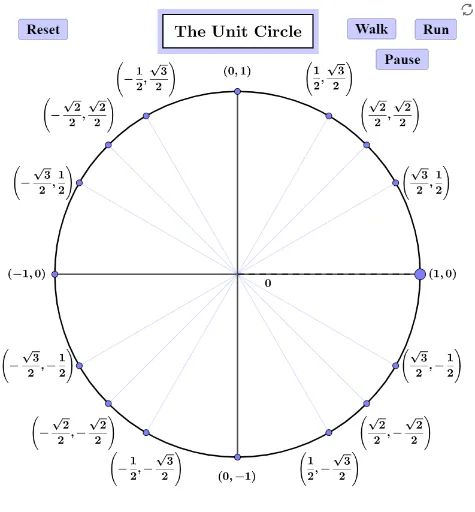
This example demonstrates the dynamic relationship between a point, vector, and trigonometric values (sine, cosine) on a unit circle. It involves core mathematical concepts such as the unit circle, trigonometric functions, vectors, and analytical geometry. Key GeoGebra commands and objects used include If, Intersect, Point, Segment, CircleArc, OrthogonalLine, Circle, Polygon, CircleSector, LaTeX, Numerator, Denominator. Suitable for high school mathematics teaching to visually understand the connection between trigonometric functions and geometric figures, enhancing spatial reasoning skills.
GeoGebra Commands & Parameters
If(smooth ≟ 0, ((step1 + step2 + step3 + step4 + step5 + step6 + step7 + step8 + step9 + step10 + step11 + step12 + step13 + step14 + step15 + step16) * π / 6) + ((2 * π) * n), smoothplay) → argumentIntersect(xAxis, yAxis) → CPoint(snap) → DPoint(p) → ZPoint(snap) → BIf(n ≥ 1, 359.99 + (0.01 * (n^(2) - 1) / n^(2)), 0.01 / (n^(2) + 1)) → closeIntersect(xAxis, yAxis) → AIf(Row[A2] / 2 ≟ ceil(Row[A2] / 2), LaTeX["\text{" + (Row[A3]) + "\pi}"], Row[A3] + 1) → A4If(Row[A3] / 2 ≟ ceil(Row[A3] / 2), LaTeX["\text{" + (Row[A4]) + "\pi}"], Row[A4] + 1) → A5If(Row[A4] / 2 ≟ ceil(Row[A4] / 2), LaTeX["\text{" + (Row[A5]) + "\pi}"], Row[A5] + 1) → A6If(Row[A5] / 2 ≟ ceil(Row[A5] / 2), LaTeX["\text{" + (Row[A6]) + "\pi}"], Row[A6] + 1) → A7If(Row[A6] / 2 ≟ ceil(Row[A6] / 2), LaTeX["\text{" + (Row[A7]) + "\pi}"], Row[A7] + 1) → A8If(Row[A7] / 2 ≟ ceil(Row[A7] / 2), LaTeX["\text{" + (Row[A8]) + "\pi}"], Row[A8] + 1) → A9If(Row[A8] / 2 ≟ ceil(Row[A8] / 2), LaTeX["\text{" + (Row[A9]) + "\pi}"], Row[A9] + 1) → A10If(Row[A9] / 2 ≟ ceil(Row[A9] / 2), LaTeX["\text{" + (Row[A10]) + "\pi}"], Row[A10] + 1) → A11If(Row[A10] / 2 ≟ ceil(Row[A10] / 2), LaTeX["\text{" + (Row[A11]) + "\pi}"], Row[A11] + 1) → A12If(Row[A11] / 2 ≟ ceil(Row[A11] / 2), LaTeX["\text{" + (Row[A12]) + "\pi}"], Row[A12] + 1) → A13If(Row[A12] / 2 ≟ ceil(Row[A12] / 2), LaTeX["\text{" + (Row[A13]) + "\pi}"], Row[A13] + 1) → A14If(Row[A13] / 2 ≟ ceil(Row[A13] / 2), LaTeX["\text{" + (Row[A14]) + "\pi}"], Row[A14] + 1) → A15If(Row[A14] / 2 ≟ ceil(Row[A14] / 2), LaTeX["\text{" + (Row[A15]) + "\pi}"], Row[A15] + 1) → A16If(Row[A15] / 2 ≟ ceil(Row[A15] / 2), LaTeX["\text{" + (Row[A16]) + "\pi}"], Row[A16] + 1) → A17If(Row[A16] / 2 ≟ ceil(Row[A16] / 2), LaTeX["\text{" + (Row[A17]) + "\pi}"], Row[A17] + 1) → A18If(cosine, LaTeX["\text{\cos}"], If[sine, LaTeX["\text{\sin}"], LaTeX["\text{\tan}"]]) → functiontextIf(cosine, LaTeX["\fcolorbox{black}{white}{\text{The Cosine Function}}"], If[sine, LaTeX["\fcolorbox{black}{white}{\text{The Sine Function}}"], LaTeX["\fcolorbox{black}{white}{\text{The Tangent Function}}"]]) → TitleIf(cosine, LaTeX["\fcolorbox{black}{white}{\text{The Cosine Function}}"], If[sine, LaTeX["\fcolorbox{black}{white}{\text{The Sine Function}}"], LaTeX["\fcolorbox{black}{white}{\text{The Tangent Function}}"]]) → TitleguideSegment((1, 0), (-1, 0)) → b_1Segment((0, 1), (0, -1)) → h_2Segment(A, D_1) → fCircleArc(A, (1 / 3 * D), (1 / 3 * D_1)) → gCircleArc(A, (2 / 3 * D), (2 / 3 * D_1)) → hIf(0 < argument ≤ (2 * π), (1 / 3 * D_1), If[argument > (2 * π), (2 / 3 * D_1)]) → EOrthogonalLine(E, f) → iCircle(E, arrowlength) → qIntersect(q, i, 1) → FOrthogonalLine(F, i) → jCircle(F, arrowwidth) → rIntersect(r, j, 1) → GIntersect(r, j, 2) → HPolygon(E, H, G) → t1, g_1, e_1, h_1CircleSector(A, (1 / 3, 0), (1 / 3 * D_1)) → cIf(sine, If[0 ≤ x ≤ argument, sin(x)], If[cosine, If[0 ≤ x ≤ argument, cos(x)], If[0 ≤ x ≤ argument, tan(x)]]) → trigLaTeX("\text{\frac{\sqrt{3}}{2}}") → s32LaTeX("\text{\minus\frac{\sqrt{3}}{2}}") → ns32LaTeX("\text{\frac{\sqrt{2}}{2}}") → s22LaTeX("\text{\minus\frac{\sqrt{2}}{2}}") → ns22LaTeX("\text{\frac{1}{2}}") → ohLaTeX("\text{\minus\frac{1}{2}}") → nohLaTeX("\text{0}") → zeroLaTeX("\text{1}") → oneLaTeX("\text{\minus 1}") → noneCircleSector(A, (2 / 3, 0), (2 / 3 * D_1)) → dNumerator(argument / π) → numDenominator(argument / π) → denomIf(num ≠ 1 ∧ denom ≠ 1, LaTeX[(((("\text{\frac{" * LaTeX[num]) * "\pi}{") * LaTeX[denom]) * "}}")], If[num ≟ 1 ∧ denom ≠ 1, LaTeX[(("\text{\frac{\pi}{" * LaTeX[denom]) * "}}")], If[denom ≟ 1 ∧ num ≠ 1 ∧ num ≠ 0, LaTeX[(("\text{" * LaTeX[num]) * "\pi}")], If[num ≟ 0, LaTeX["\text{0}"], LaTeX["\text{\pi}"]]]]) → text34If(num ≠ 1 ∧ denom ≠ 1, LaTeX[(((("\text{\frac{" * LaTeX[num]) * "\pi}{") * LaTeX[denom]) * "}}")], If[num ≟ 1 ∧ denom ≠ 1, LaTeX[(("\text{\frac{\pi}{" * LaTeX[denom]) * "}}")], If[denom ≟ 1 ∧ num ≠ 1 ∧ num ≠ 0, LaTeX[(("\text{" * LaTeX[num]) * "\pi}")], If[num ≟ 0, LaTeX["\text{0}"], LaTeX["\text{\pi}"]]]]) → text34guideIf(0 ≤ argument ∧ argument < (2 * π), argument, If[(2 * π) ≤ argument ∧ argument < (4 * π), argument - (2 * π), argument - (4 * π)]) → argforreadIf(smooth ≟ 1, LaTeX["y"], If[cosine, LaTeX[cosoutput], If[sine, LaTeX[sinoutput], LaTeX[tanoutput]]]) → outputSegment(I, Tracepoint) → lSegment(Tracepoint, J) → mIf(smooth ≟ 1, LaTeX["y"], If[cosine, LaTeX[cosoutput], If[sine, LaTeX[sinoutput], LaTeX[tanoutput]]]) → guideoutputIf((¬(D_1 ∈ snap)) ∨ smooth ≟ 1, LaTeX["x"], If[showdegrees, LaTeX[degtext], LaTeX[text34]]) → guidextextIf((¬(D_1 ∈ snap)) ∨ smooth ≟ 1, LaTeX["x"], If[showdegrees, LaTeX[degtext], LaTeX[text34]]) → graphxtextIf(tangent, "tan", If[cosine, "cos", If[sine, "sin"]]) → functext