
Exploring the Unit Circle
Loading the math board and drawing, please wait…
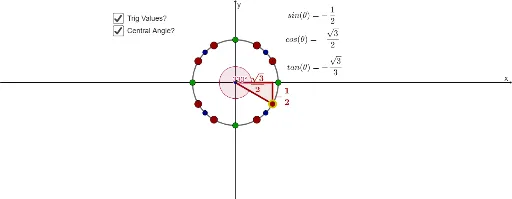
This example demonstrates the unit circle and its connection with special right triangles. It involves core math concepts like the definition of the unit circle, trigonometric values, and geometric representations of special angles (30°, 45°, 60°). Construction highlights include using GeoGebra commands such as Point, Sequence, Segment, Min, If, Polygon, Element, Random, Angle to build the unit circle, special triangles, and angle relationships. Suitable for high school mathematics education to understand the relationship between trigonometric functions and geometric shapes.
GeoGebra Commands & Parameters
Point(c) → ASequence(((π * k)) / 12, k, 0, 24) → AnglesSequence((cos(Element[Angles306090, k]), sin(Element[Angles306090, k])), k, 1, 9) → Pts306090Segment(O, B) → dMin(abs(Angles306090 - acosd(x(A)))) → d306090Min(abs(Angles459045 - acosd(x(A)))) → d459045Min(abs(AnglesVH - acosd(x(A)))) → dVHIf(d306090 ≤ d459045 ∧ d306090 ≤ dVH, 1, 0) → is306090If(d459045 < d306090 ∧ d459045 < dVH, 1, 0) → is459045If(dVH < d306090 ∧ dVH < d459045, 1, 0) → isVHIf(y(A) > 0, acosd(x(A)), π + acosd((-x(A)))) → thetaPolygon(O, A, B) → Triangle306090, b, o, aPolygon(O, A, B) → Triangle459045, b_1, o_1, a_1Polygon(O, A, B) → TriangleVH, b_2, o_2, a_2Sequence((cos(Element[Angles459045, k]), sin(Element[Angles459045, k])), k, 1, 4) → Pts459045Sequence((cos(Element[AnglesVH, k]), sin(Element[AnglesVH, k])), k, 1, 4) → PtsVHSequence((cos(Element[AnglesAll, k]), sin(Element[AnglesAll, k])), k, 1, Length[AnglesAll]) → PtsAllElement(AnglesAllLabels, 2) → FailRandom(1, 14) → randIntIf(π / 2 < theta ∧ theta < ((3 * π)) / 2, "-", "") → negCosIf(tan(theta) < 0, "-", "") → negTanAngle(O2, O, A) → alphaGreenIf(theta ≟ π / 3 ∨ theta ≟ (2 * π / 3) ∨ theta ≟ (4 * π / 3) ∨ theta ≟ (5 * π / 3), 1) → isTall306090If(theta ≟ π / 6 ∨ theta ≟ (5 * π / 6) ∨ theta ≟ (7 * π / 6) ∨ theta ≟ (11 * π / 6), 1) → isSkinny306090If(theta ≟ π / 4 ∨ theta ≟ (3 * π / 4) ∨ theta ≟ (5 * π / 4) ∨ theta ≟ (7 * π / 4), 1) → isReal459045If(theta ≟ 0 ∨ theta ≟ π ∨ theta ≟ (2 * π), 1) → isHPoint(xAxis) → CPoint(xAxis) → DPoint(xAxis) → EPoint(xAxis) → FPoint(yAxis) → GPoint(yAxis) → HPoint(yAxis) → IPoint(yAxis) → JPoint(c_1) → A_1Point(c_2) → A_2Angle(O2, O, A) → alphaRedAngle(O2, O, A) → alphaBluePoint(c_3) → A_3If(y(A_3) > 0, acosd(x(A_3)), π + acosd((-x(A_3)))) → theta_1If(π < theta ∧ theta < (2 * π), "-", "") → negSin
AI Drawing Prompt Reference
Draw a unit circle and mark the points corresponding to special angles like 30°, 45°, and 60° on it. Connect these points to the origin to form three special right triangles. Also, mark the projection points of the unit circle on the coordinate axes and display the trigonometric values of these angles. Use different colors to distinguish the triangles for different angles and label the angle values and trigonometric values.
The prompt above was compiled from the original drawing commands and is for reference only.