
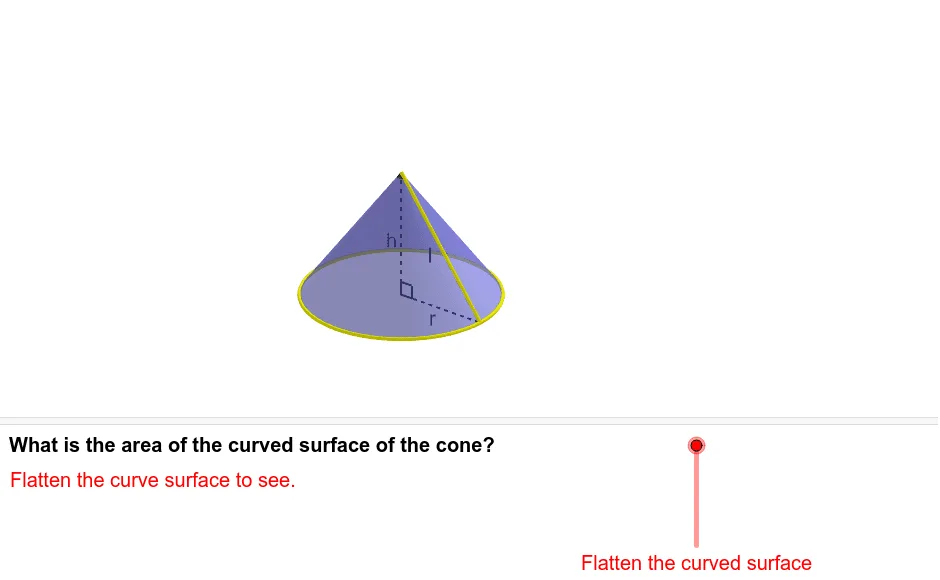
Unfolding the Curved Surface of a Cone
Loading the math board and drawing, please wait…
This example demonstrates how the curved surface of a cone can be flattened into a sector, and how rearranging the sector helps understand its area formula πrl. It involves concepts of cones, sectors, and triangles, and uses GeoGebra commands such as points, arcs, and vectors for construction. Suitable for middle school and above students learning solid geometry and area calculation.
GeoGebra Commands & Parameters
Point(CircleArc[(0, 1), (1, 1), (0, 0)]) → QIf(y(Q) > 0, CircleArc[(0, 1), (0, 0), Q], 6.283185307179586) → sIf(y(Q) > 0, Angle[(0, 0), (0, 1), Q], 6.283185307179586) → α'Sequence((sin((i * θ)), 1 - cos((i * θ))), i, 0, (2 * n)) → list1If(t ≤ 1, t, 1) → kIf(t ≥ 1, t - 1, 0) → k'Sequence(If[k < 1, (x(O_1) + ((l * sin((i * φ))) * cos((i * φ)) / sin(φ)), y(O_1) + ((l * sin((i * φ))) * sin((i * φ)) / sin(φ))), (x(O_1) + (l * i), y(O_1))], i, 0, (2 * n)) → list2Sequence(Sector[Rotate[Translate[Circle[(x(O_1) + 0, y(O_1) + 1), Element[list1, i]], Vector[Element[list1, i], Element[list2, i]]], (((-((2 * i) - 1)) * k) * θ / 2), Element[list2, i]], Rotate[Translate[Element[list1, i], Vector[Element[list1, i], Element[list2, i]]], (((-((2 * i) - 1)) * k) * θ / 2), Element[list2, i]], Rotate[Translate[Element[list1, i + 1], Vector[Element[list1, i], Element[list2, i]]], (((-((2 * i) - 1)) * k) * θ / 2), Element[list2, i]]], i, 1, n) → list3Sequence(Sector[Rotate[Rotate[Translate[Circle[(x(O_1) + 0, y(O_1) + 1), Element[list1, i]], Vector[Element[list1, i], Element[list2, i]]], (((-((2 * i) - 1)) * k) * θ / 2), Element[list2, i]], (180° * k'), (x(O_1) + (n * l) - sin(θ / 2) / 2, y(O_1) + cos(θ / 2) / 2)], Rotate[Rotate[Translate[Element[list1, i], Vector[Element[list1, i], Element[list2, i]]], (((-((2 * i) - 1)) * k) * θ / 2), Element[list2, i]], (180° * k'), (x(O_1) + (n * l) - sin(θ / 2) / 2, y(O_1) + cos(θ / 2) / 2)], Rotate[Rotate[Translate[Element[list1, i + 1], Vector[Element[list1, i], Element[list2, i]]], (((-((2 * i) - 1)) * k) * θ / 2), Element[list2, i]], (180° * k'), (x(O_1) + (n * l) - sin(θ / 2) / 2, y(O_1) + cos(θ / 2) / 2)]], i, n + 1, (2 * n)) → list4CircleArc((0, 1 / (1 - m)), O_1, L) → bSegment((0, 0), (s, 0)) → dMidpoint(d) → B'CircleArc((0, 1), Q, (0, 0)) → cSegment(O, (x(O), y(O) - 1)) → eMidpoint(e) → GCircle((0, 1), 1) → gMidpoint(Q, O) → HSegment(O, A) → aCircle(P, 1, yAxis) → pIntersect(xOyPlane, p) → D, CRotate(O_1, α, a) → FSurface((u * cos(v)), (u * sin(v)) + 1, f(u), u, 0, abs(x(D)), v, -1.5708, (3 * π / 2) - (2 * γ)) → oRotate(D_1, α, a) → D'CircumcircleArc(D_1, C, D') → qCircle(O, D_1, a) → c_1Segment(P, D') → iSegment(P, D_1) → a_1Point(b) → JSegment(O, D_1) → b_1Vector(A + (0, 0, 0.3), A + (0, 0, 0.06)) → uAngle(D_1, O, A) → β