
Understanding the Chain Rule
Loading the math board and drawing, please wait…
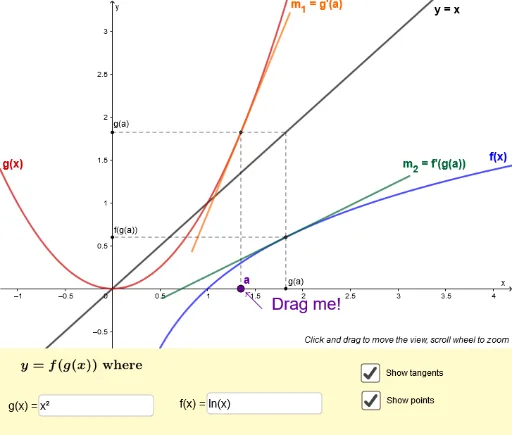
This example demonstrates how the derivative of a composite function $f(g(x))$ depends on the derivatives of both $f$ and $g$. By dynamically adjusting the functions $f$ and $g$, one can intuitively understand the essence of the chain rule. The construction involves points, functions, and slider animations in GeoGebra. Suitable for teaching derivatives in calculus courses.
GeoGebra Commands & Parameters
Point(xAxis) → ASegment(A, P1) → l1Segment((0, g(a)), (a, g(a))) → l2aSegment((a, g(a)), (g(a), g(a))) → l2bSegment((g(a), g(a)), (g(a), f(g(a)))) → l3aSegment((g(a), f(g(a))), (g(a), 0)) → l3bSegment((g(a), f(g(a))), (0, f(g(a)))) → l4aPolygon({Corner[2], Corner[1], (4 / 5 * Corner[1]) + (1 / 5 * Corner[4]), (4 / 5 * Corner[2]) + (1 / 5 * Corner[3])}) → consoleTextfield(g) → InputBox1Textfield(f) → InputBox2