
Visualization of the ε-M Definition of Sequence Convergence
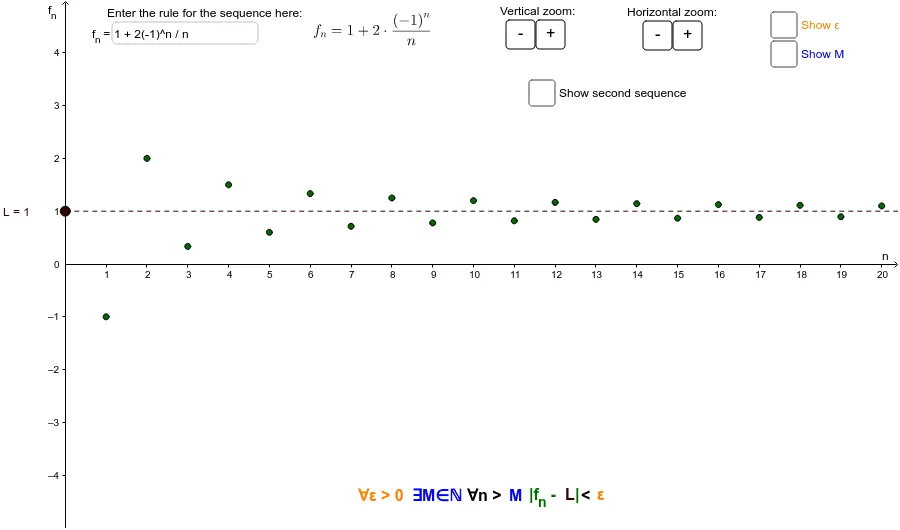
This GeoGebra applet provides an interactive visualization of the rigorous epsilon-M (or epsilon-N) definition of sequence convergence. Users can adjust parameters such as epsilon (the error bound) and M (the index threshold) to dynamically observe how the terms of a sequence are distributed relative to a limiting value. The construction categorizes each point on the graph into good points or bad points depending on whether the corresponding sequence term falls within the epsilon-neighborhood of the limit. The epsilon-neighborhood, represented as the open interval (L - epsilon, L + epsilon) around the limit L, is highlighted visually so users can clearly see which terms satisfy the convergence condition and which do not. As the user increases the threshold M, they can observe that all terms with indices greater than M lie within the epsilon strip, illustrating the key idea that no matter how small epsilon is chosen, one can always find a sufficiently large M beyond which every subsequent term stays within the prescribed distance from the limit. This geometric perspective helps students internalize the formal definition: for any given epsilon greater than zero, there exists a positive integer M such that for all n greater than M, the absolute value of the difference between the sequence term a_n and the limit L is less than epsilon. By manipulating the sliders interactively, learners gain intuition about the quantifier structure of the definition — the universal quantification over epsilon and the existential quantification over M — and understand why this precise formulation captures the intuitive notion that a sequence gets arbitrarily close to its limit as the index grows without bound. The visual distinction between good and bad points, combined with the dynamic highlighting of the epsilon-neighborhood, makes an abstract analysis concept concrete and accessible, bridging the gap between informal understanding and rigorous proof-based reasoning in real analysis and calculus courses.
In collections
Mathematical Analysis Lecture Notes
Loading the math board and drawing, please wait…