
Two Dice from Three Dice Problem
Loading the math board and drawing, please wait…
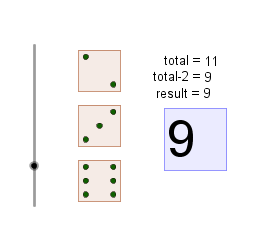
This example demonstrates how to simulate a two-dice probability distribution using three indistinguishable dice. It involves core math concepts like Probability & Statistics, Polygon construction, Parametric Equations, and Vector operations. The construction uses GeoGebra commands such as Mod, If, Polygon, Sum, and objects like n, a, b, c, d_1, d_2, d_3. It is suitable for high school and above students to understand the integration of probability theory and geometric constructions.
GeoGebra Commands & Parameters
Mod(n, 6) → aMod(floor((n - 1) / 6) + 1, 6) → bMod(floor((n - 1) / 36) + 1, 6) → cIf(a ≟ 0, 6, a) → d_1If(b ≟ 0, 6, b) → d_2If(c ≟ 0, 6, c) → d_3Polygon((2, 2) + diecorner) → dieedge_1Polygon((2, 6) + diecorner) → dieedge_2Polygon((2, 10) + diecorner) → dieedge_3Sum((equalness * {d_1, d_2, d_3})) → totalIf(total ≟ 0, 0, total - 2) → adjtotalIf(adjtotal < 2, adjtotal + 7, If[adjtotal > 12, adjtotal - 7, adjtotal]) → resultPolygon((9, 5) + (1.5 * diecorner)) → poly1