
Two-column proof (rhombus)
Loading the math board and drawing, please wait…
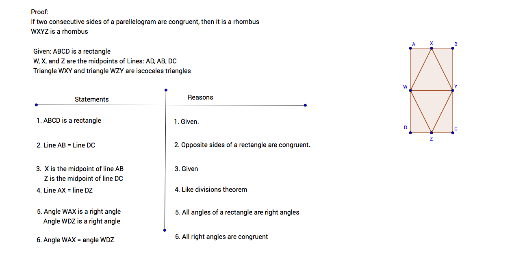
This example demonstrates a two-column proof for the properties of a rhombus, involving core concepts like parallelogram properties, vector equality, and side/angle relationships. Construction highlights include using Segment and Polygon commands, with objects like text1-16, points G-H, I-J, segments d-e, points X-Y, and polygons poly1-poly3. Suitable for high school geometry proof instruction and learning.
GeoGebra Commands & Parameters
Segment(G, H) → dSegment(I, J) → ePolygon(X, B, Y) → poly1, c, a, bPolygon(X, A, W) → poly2, e_1, a_1, d_1Polygon(W, Y, X) → poly3, a_2, e_2, c_1Polygon(W, D, Z) → poly4, k, e_3, fPolygon(Z, C, Y) → poly5, c_2, k_1, lPolygon(Z, W, Y) → poly6, c_3, k_2, e_4
AI Drawing Prompt Reference
Draw a rhombus and prove it is a parallelogram. First, draw two diagonals d and e, then connect points X, B, Y; X, A, W; W, Y, X; W, D, Z; Z, C, Y; Z, W, Y, to form six polygons, demonstrating the properties of the rhombus and the proof process.
The prompt above was compiled from the original drawing commands and is for reference only.