
Truncated Pyramid Construction and Properties
Loading the math board and drawing, please wait…
In collections
truncated pyramid
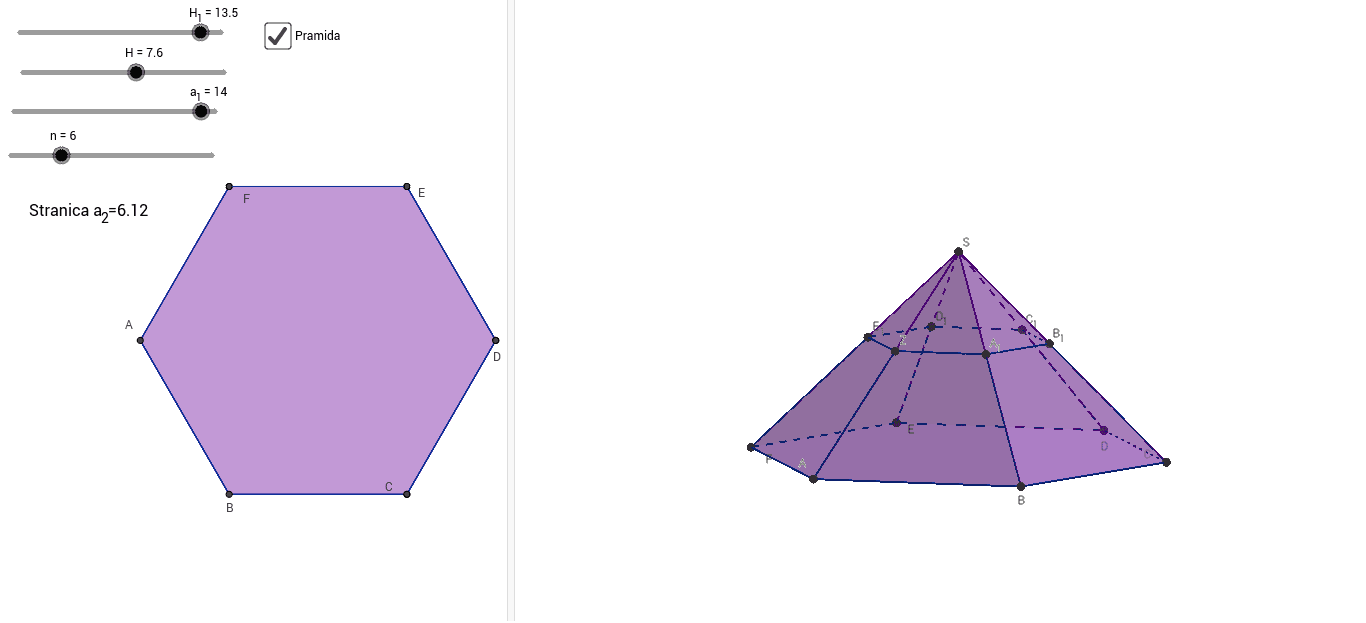
This example demonstrates the construction and properties of a truncated pyramid. Key mathematical concepts include solid geometry, spatial figures, and geometric construction. The construction involves using GeoGebra commands such as Intersect, Circle, Polygon, Pyramid, Plane, and IntersectPath to build the pyramid model, with spatial positioning via Plane and other tools. Suitable for high school students or college undergraduates to learn solid geometry and spatial visualization skills.
GeoGebra Commands & Parameters
Intersect(xAxis, yAxis) → OCircle(O, R) → cIntersect(c, xAxis, 1) → ACircle(A, a_1) → dIntersect(d, c) → Q, B, ,Polygon(A, B, n) → poly1, a, l, m, p, q, r, s, t, C, D, E, b, F, G, I, J, K, L, M, N, P, T, e, T_2, f, g, h, i, j, kPyramid(poly1, S) → o, faceABS, face5, face6, face7, face8, face9, face10, edgeAS, edgeBS, edgeCS, edgeDS, faceBCS, edgeES, edge1, edge2, edge3, edge4, edge5, edge6, edge7, edge8, edge9, faceCDS, edge10, faceDES, faceAES, face1, face2, face3, face4Plane(W, V, U) → uIntersectPath(u, o) → poly2, Z, J_1, K_1, L_1, M_1, N_1, O_1, b_1, c_1, d_1, e_1, A_1, f_1, l_1, m_1, n_1, p_1, q_1, r_1, s_1, t_1, d_2, B_1, e_2, C_1, D_1, E_1, F_1, G_1, I_1Segment(C_1, D) → g_1Segment(D_1, E) → h_1Segment(Z, A) → i_1Segment(A_1, B) → j_1Segment(B_1, C) → k_1Segment(E_1, F) → a_2Segment(G_1, I) → b_2Segment(G, F_1) → c_2Segment(K, J_1) → f_2Segment(L, K_1) → g_2Segment(M, L_1) → h_2Segment(N, M_1) → i_2Segment(P, N_1) → j_2Segment(T, O_1) → k_2Segment(J, I_1) → l_2Polygon(A, B, L, M, N, P, T, C, D, E, F, G, I, J, K) → poly3, a_3, k_3, l_3, m_2, n_2, p_2, s_2, b_3, c_3, d_3, e_3, f_3, g_3, i_3, j_3Polygon(A, B, n) → poly4, q_2, s_3, t_3, a_4, b_4, c_4, d_4, P_1, Q_1, R_1, T_1, r_2, U_1, V_1, W_1, Z_1, A_2, B_2, C_2, D_2, E_2, t_2, h_3, m_3, n_3, p_3, q_3, r_3Distance(M_1, N_1) → wDistance(A_1, B_1) → o_1
AI Drawing Prompt Reference
Draw a truncated pyramid. First, determine a point O on the plane. Then draw a circle c. Find the intersection of circle c with the x-axis to get point A. Draw a circle d centered at A. Find the intersections of circle d with circle c to get points Q and B. Construct a polygon poly1 using these points. Then construct a pyramid using poly1. Draw a plane u on the plane. Find the intersection of plane u with the pyramid to get poly2. Draw segments such as from C1 to D1, D1 to E1, etc. Construct another polygon poly3 and poly4. Finally, calculate distances like M1 to N1 and A1 to B1. The overall figure shows the construction and properties of a truncated pyramid, suitable for learning solid geometry and spatial visualization.
The prompt above was compiled from the original drawing commands and is for reference only.