
Trigonometric Functions: Sine, Cosine, and Tangent via the Unit Circle
Loading the math board and drawing, please wait…
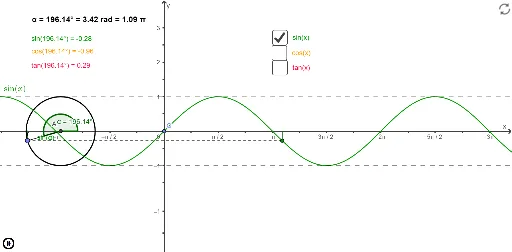
This GeoGebra example dynamically illustrates the sine, cosine, and tangent functions using the unit circle, linking geometric definitions to their graphical representations. Core mathematical concepts include the three basic trigonometric functions, the unit circle, angle measurement in radians and degrees, and the periodic nature of these functions. The construction employs commands such as Circle to create the unit circle, Point to place a moving point on the circle, Segment and Angle to define the angle, OrthogonalLine and Intersect to construct perpendiculars and intersection points, and Line with Sequence to generate the function graphs and auxiliary lines. A slider controls the angle, allowing real-time visualization of how the trigonometric values change. This resource is ideal for high school and introductory college students learning trigonometric definitions, graph properties, and the connection between the unit circle and function curves, as well as for teachers demonstrating these concepts in class.
GeoGebra Commands & Parameters
Circle(A, 1) → cPoint(c) → BSegment(A, B) → bPoint(xAxis) → CAngle(C, A, B) → αOrthogonalLine(B, xAxis) → dIntersect(xAxis, d) → DSegment(A, D) → eSegment(D, B) → fLine(A, B) → hIntersect(g, h) → FSegment(F, E) → kSegment(F, J) → nSegment(B, I) → pSegment(B, (x(B), 0)) → sSegment(K, (x(K), 0)) → iSegment(A, F) → jSequence(x = (((2 * k) + 1) * π / 2), k, -10, 10) → Liste1Segment(G, I) → q
AI Drawing Prompt Reference
Draw a unit circle centered at the origin with radius 1. Place a movable point on the circle and connect it to the center with a radius segment. Choose a point on the positive x-axis, and define an angle at the center between the positive x-axis and the radius segment, controlled by a slider. From the point on the circle, drop a perpendicular to the x-axis, marking the foot, and draw segments connecting the center to the foot and the foot to the circle point. Extend the line through the center and the circle point to intersect a vertical auxiliary line, then connect this intersection to several auxiliary points with segments. Additionally, draw a series of vertical dashed lines at odd multiples of π/2 to indicate asymptotes. The whole figure links the unit circle definitions of sine, cosine, and tangent to their graphical representations.
The prompt above was compiled from the original drawing commands and is for reference only.