
Trigonometric Functions on the Unit Circle by Mario
Loading the math board and drawing, please wait…
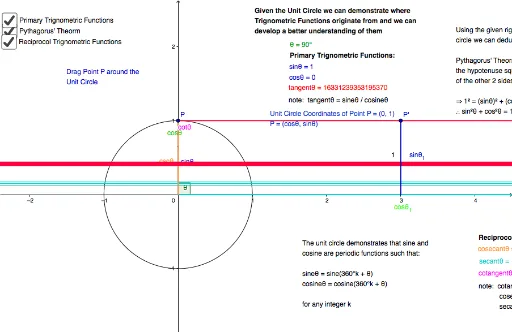
This example demonstrates how points on the unit circle represent trigonometric function values. Key mathematical concepts include trigonometric functions, the unit circle, and angles. Using GeoGebra commands such as Circle, Point, and Tangent, dynamic displays of trigonometric function properties are shown. Suitable for high school mathematics education and learning.
GeoGebra Commands & Parameters
Circle(A, B) → cPoint(c) → POrthogonalLine(A, yAxis) → aOrthogonalLine(P, a) → bOrthogonalLine(P, yAxis) → dSegment(A, P) → eIntersect(yAxis, d) → CIntersect(b, a) → DSegment(P, C) → cosθSegment(D, P) → sinθTangent(P, c) → h,Intersect(yAxis, h) → EIntersect(a, h) → FSegment(F, A) → secθSegment(A, E) → cscθSegment(P, E) → cotθSegment(P, F) → tanθAngle(P, A, B) → θPolygon(P, A, D) → poly1, d_1, p, a_1Vector(A, G) → uTranslate(P, u) → P'Translate(A, u) → A'Translate(D, u) → D'Polygon(P', A', D') → poly1', d', cosθ_1, sinθ_1Angle(P', A', D') → θ_1
AI Drawing Prompt Reference
Draw a point P on the unit circle and draw a line perpendicular to the y-axis through P. Then draw the perpendicular from P to the y-axis, the perpendicular from P to the line perpendicular to the y-axis, and the line segment from P to the center A. Draw the line segment from P to the foot of the perpendicular C to represent cosine, and the line segment from P to the foot of the perpendicular D to represent sine. Draw the tangent line at P, and the intersection points with the y-axis and the line perpendicular to the y-axis represent secant and cosecant, and the intersection with the line perpendicular to the y-axis represents tangent. Finally, draw angle θ and a polygon with points P, A, and D. Translate points P, A, and D by the same vector u and draw a new polygon.
The prompt above was compiled from the original drawing commands and is for reference only.