
Triangular Pyramid (Tetrahedron) Dynamic Construction and 3D Geometry Exploratio
Loading the math board and drawing, please wait…
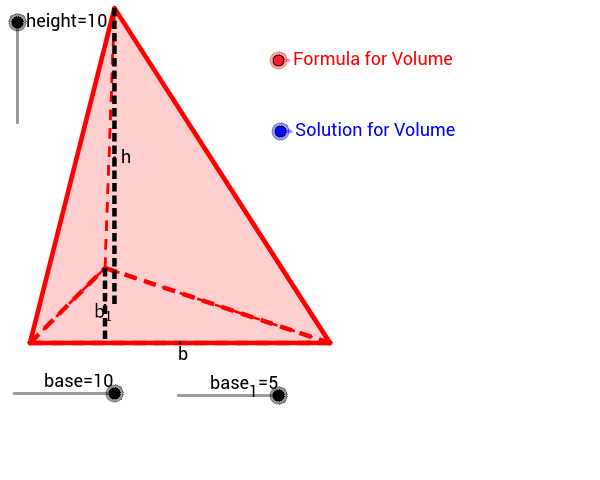
This GeoGebra example demonstrates the step-by-step dynamic construction of a triangular pyramid (tetrahedron), visually presenting its base, lateral faces, edges, height, and spatial relationships among vertices in three-dimensional space. The core mathematical concepts covered include solid geometry, polyhedra, triangular pyramids, base and lateral faces, altitude, midpoint, angle bisector, vector translation, dilation, and geometric transformations. Construction highlights: Line, Circle, and Intersect are used to build the base and intersection points; Polygon and Segment draw the faces and edges; Midpoint and AngularBisector handle midpoints and angle bisectors; Vector, Dilate, and Translate generate translated and scaled points, while the If command enables conditional logic and dynamic visibility. Key objects include base vertices A, B, C, D, apex S, height, midpoints M and H, and related construction elements. This resource is suitable for middle and high school solid geometry instruction, teacher classroom demonstrations, and student-led exploration of 3D geometric structures.
GeoGebra Commands & Parameters
Line(J, K) → hCircle(J, base_1) → gIntersect(g, h, 1) → MVector(J, M) → wDilate(I, base, H) → LVector(H, L) → vTranslate(A, v) → BMidpoint(A, B) → CMidpoint(C, A) → DTranslate(D, Vector[w / 2]) → NAngularBisector(A, N, B) → lAngularBisector(B, A, N) → kIntersect(k, l) → ODilate(F, height, E) → GVector(E, G) → uTranslate(O, u) → D_1Circle(J, 1) → dPolygon(A, N, B) → P, b, a, nPolygon(D_1, A, N) → Q, n_1, n', a_1Polygon(D_1, B, N) → R, n_2, n'_1, b_1Polygon(A, D_1, B) → S, b_2, a_2, n'_2Segment(N, D) → cMidpoint(N, D) → TIf(VolumeFormula ≟ 1, U) → ZIf(VolumeSolution ≟ 1, V) → A_1Segment(D_1, O) → mMidpoint(D_1, O) → C_1
AI Drawing Prompt Reference
Draw a dynamic construction of a tetrahedron (triangular pyramid). The figure should include a triangular base with vertices A, B, C, and a vertex S. Also show the lateral faces, edges, and the height of the tetrahedron. Highlight the spatial relationships among the vertices. The construction should proceed from the base to the apex, using tools like midpoints and angle bisectors to maintain accuracy. This is suitable for geometry teaching and exploration.
The prompt above was compiled from the original drawing commands and is for reference only.