
Triangular Prism by Mathguru
Loading the math board and drawing, please wait…
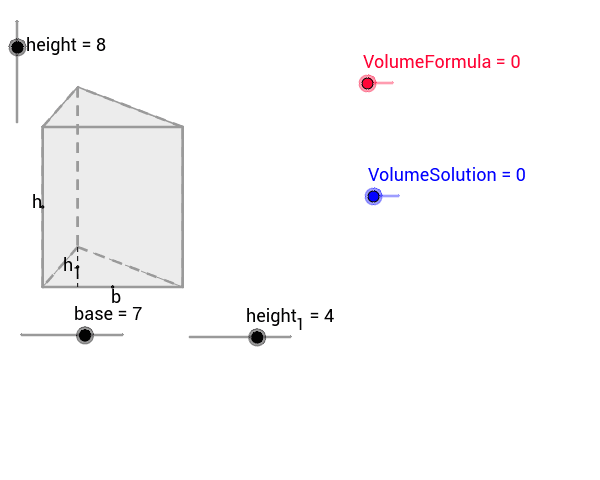
This GeoGebra example dynamically constructs a triangular prism and explores its geometric properties. It demonstrates related concepts such as prism volume, similar triangles, inscribed and circumscribed circles, similarity transformations, and rational numbers. The construction employs GeoGebra commands including Dilate, Vector, Circle, Line, Intersect, Translate, Midpoint, Polygon, Segment, If, and AngularBisector, using point objects to build prism faces and bases. It is suitable for middle and high school geometry education, helping learners visualize and understand the structure and properties of triangular prisms.
GeoGebra Commands & Parameters
Dilate(F, height, E) → GVector(E, G) → uDilate(I, base, H) → LVector(H, L) → vCircle(J, height_1) → gLine(J, K) → hIntersect(g, h, 1) → MVector(J, M) → wTranslate(A, v) → BCircle(J, 1) → dMidpoint(A, B) → CMidpoint(C, A) → DTranslate(D, Vector[w / 2]) → NPolygon(A, N, B) → P, b, a, nTranslate(A, u) → A'Translate(N, u) → N'Translate(B, u) → B'Polygon(A', N', B') → P', b', a', n'Polygon(A', N', N, A) → Q, a'_1, n'_1, n_1, a_1Polygon(N', N, B, B') → R, n'_2, n_2, b_1, b'_1Polygon(B', B, A, A') → S, b'_2, b_2, a_2, a'_2Segment(N, D) → cMidpoint(A, A') → OMidpoint(N, D) → TIf(VolumeFormula ≟ 1, U) → ZIf(VolumeSolution ≟ 1, V) → A_1AngularBisector(A, N, B) → eAngularBisector(B, A, N) → fIntersect(f, e) → WTranslate(W, u) → Y