
Triangle Properties Explorer
Loading the math board and drawing, please wait…
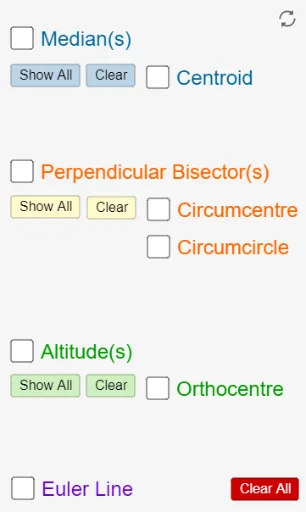
① This interactive GeoGebra applet dynamically explores various properties of triangles, including medians, centroid, circumcircle, and perpendicular lines. ② Core mathematical concepts include triangle medians and centroid (barycenter), perpendicular bisectors and circumcircle, angle-side relationships, and inequalities related to sine and random variables in a geometric context. ③ Construction highlights: based on the summary, the applet uses GeoGebra commands such as Line, Segment, Midpoint, Intersect, OrthogonalLine, Circle, Polygon, Angle, Vector, and Translate, creating vertices A, B, C, three medians (median1, median2, median3), their intersection centroid, and buttons to toggle visibility of medians, perpendiculars, circumcircle, and other objects, along with text labels. ④ Suitable for middle/high school geometry lessons, math lab activities, or self-study, helping students intuitively grasp theorems like concurrency of medians, centroid properties, circumcenter location, and perpendicular relationships.
GeoGebra Commands & Parameters
Line(B, A) → fLine(A, C) → gLine(C, B) → hSegment(B, A) → iSegment(A, C) → jSegment(C, B) → kMidpoint(i) → DMidpoint(j) → EMidpoint(k) → FSegment(A, F) → median1Segment(E, B) → median3Segment(D, C) → median2Intersect(median1, median3) → centroidOrthogonalLine(F, k) → lCircle(B, A, C) → cOrthogonalLine(D, i) → mOrthogonalLine(E, j) → nPolygon(B, A, C) → t1, c_1, b, aIntersect(l, m) → circumcentreSegment(E, circumcentre) → pSegment(F, circumcentre) → qSegment(D, circumcentre) → rIntersect(l, j) → GSegment(F, G) → sAngle(k, s) → αIntersect(l, i) → HSegment(F, H) → tAngle(k, t) → βIntersect(m, k) → ISegment(D, I) → dAngle(d, i) → γIntersect(m, j) → JSegment(J, D) → eAngle(J, D, A) → δIntersect(n, i) → KSegment(E, K) → f_1Angle(j, f_1) → εIntersect(n, k) → LSegment(E, L) → g_1Angle(j, g_1) → ζOrthogonalLine(C, i) → h_1Intersect(f, h_1) → MSegment(C, M) → i_1Segment(M, D) → j_1OrthogonalLine(B, g) → k_1Intersect(g, k_1) → NSegment(B, N) → l_1Segment(N, E) → m_1OrthogonalLine(A, k) → n_1Intersect(h, n_1) → OSegment(O, A) → q_1Segment(F, O) → p_1Vector(A, B) → uTranslate(M, u) → M'Vector(M, M') → vAngle(B, M, C) → ηAngle(B, N, C) → θAngle(C, O, A) → ιLine(circumcentre, centroid) → r_1Intersect(n_1, k_1) → PSegment(O, P) → s_1Segment(N, P) → t_1Segment(M, P) → a_1