
Triangle Inequalities by mathspace
Loading the math board and drawing, please wait…
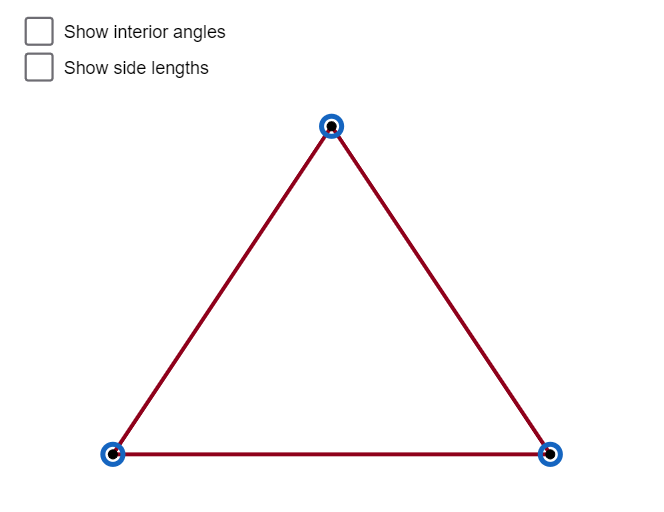
This example demonstrates the relationship between interior and exterior angles of a triangle. Using GeoGebra commands such as Polygon, Line, and Angle, you can dynamically explore the properties of triangle angles. Suitable for middle school and above students to learn about triangle inequalities.
GeoGebra Commands & Parameters
Polygon(A, B, C) → t1, c, a, bLine(B, A) → fLine(A, C) → gLine(C, B) → hAngle(B, C, A) → αAngle(C, A, B) → βAngle(A, B, C) → γCircle(A, 1) → dIntersect(t1, d) → D, EMidpoint(D, E) → FCircle(C, 1) → eIntersect(t1, e) → G, HMidpoint(G, H) → ICircle(B, 1) → kIntersect(t1, k) → J, KAngle(A, B, C) → δAngle(B, C, A) → εAngle(C, A, B) → ζPoint(f) → PSegment(A, P) → iAngle(P, B, C) → ηPoint(g) → QSegment(A, Q) → jPoint(h) → RSegment(C, R) → lAngle(R, C, A) → θAngle(Q, A, B) → ιAngle(P, B, C) → κAngle(Q, A, B) → λAngle(R, C, A) → μIntersect(d, j) → S,AngularBisector(S, A, D) → mIntersect(d, m) → T, UAngularBisector(D, A, E) → nIntersect(d, n) → V, WAngularBisector(J, B, K) → pIntersect(k, p) → Z, A_1Intersect(k, i) → B_1, C_1AngularBisector(C_1, B, K) → qIntersect(k, q) → D_1, E_1Intersect(e, l) → F_1,AngularBisector(G, C, H) → rAngularBisector(H, C, F_1) → sIntersect(e, s) → G_1, H_1Intersect(e, r) → I_1, J_1Midpoint(a) → K_1Midpoint(b) → L_1Midpoint(c) → L
AI Drawing Prompt Reference
Draw a triangle and illustrate the relationship between interior and exterior angles. Start with three triangle vertices and connect them to form the three sides, then extend each side as a line. Mark the three interior angles at the triangle’s vertices. Next, at each vertex construct a circle centered at that vertex with radius 1, intersect each circle with the relevant extended side lines to get multiple intersection points, and take midpoints of certain paired intersection points. Through several key intersection points, construct angle bisectors, then intersect these bisectors with the corresponding circles or lines to obtain additional points. Finally, display several angles formed by rays from the constructed points toward the triangle’s sides, representing the angle-bisector/exterior-angle viewpoint needed to explore triangle angle inequalities.
The prompt above was compiled from the original drawing commands and is for reference only.