
Triangle Congruency Demo
Loading the math board and drawing, please wait…
In collections
Similarity and Congruence Year 8 Pedagogies in Practice
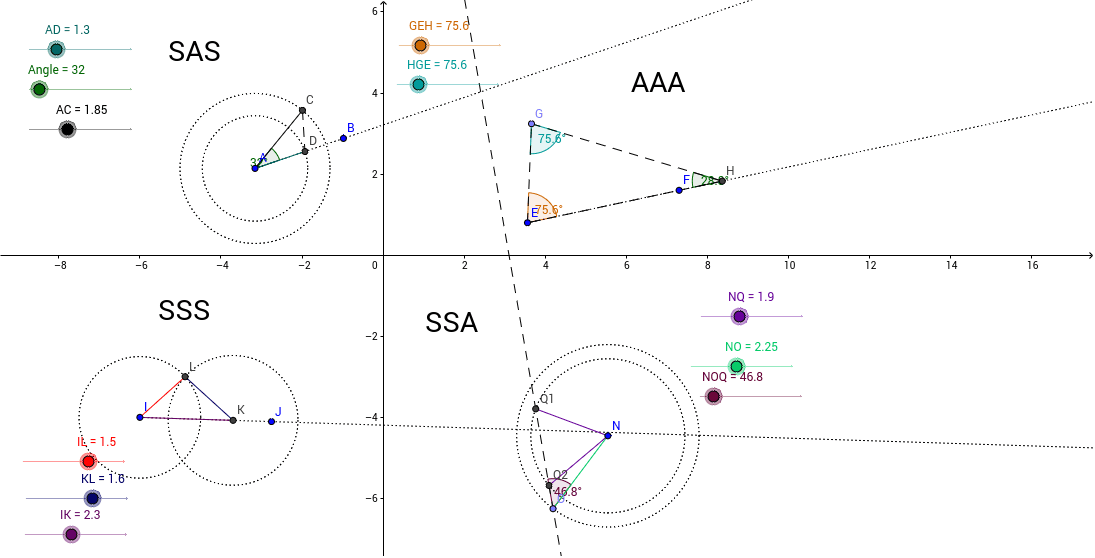
This example demonstrates the principles of triangle congruency, focusing on SAS (Side-Angle-Side) and SSS (Side-Side-Side) criteria. It involves core math concepts like triangle congruence, geometric constructions, and angle measurements. The construction uses commands like Ray, Circle, Intersect, Rotate, and objects such as Points, Segments, and Lines. Ideal for middle school students and beyond to learn geometric proofs and spatial reasoning.
GeoGebra Commands & Parameters
Ray(A, B) → aCircle(A, AD) → cIntersect(c, a, 1) → DRotate(D, Angle°, A) → D'Angle(D, A, D') → αSegment(A, D) → dRay(A, D') → fCircle(A, AC) → kIntersect(k, f, 1) → CSegment(A, C) → gSegment(C, D) → hRay(E, F) → bRotate(F, GEH°, E) → F'Angle(F, E, F') → βRay(E, F') → ePoint(e) → GRotate(E, HGE°, G) → E'Angle(E, G, E') → γRay(G, E') → iIntersect(b, i) → HSegment(E, G) → jSegment(G, H) → lSegment(H, E) → mAngle(G, H, E) → δRay(I, J) → nCircle(I, IK) → pIntersect(p, n, 1) → KCircle(I, IL) → qCircle(K, KL) → rSegment(I, K) → sIntersect(q, r, 1) → LSegment(I, L) → tSegment(L, K) → a_1Circle(N, NQ) → d_1Circle(N, NO) → e_1Point(e_1) → ORotate(N, NOQ°, O) → N'Angle(N, O, N') → εSegment(N, O) → f_1Line(O, N') → b_1Intersect(d_1, b_1, 2) → Q1Intersect(d_1, b_1, 1) → Q2Segment(N, Q1) → c_1Segment(N, Q2) → g_1
AI Drawing Prompt Reference
Draw a triangle ABC to demonstrate triangle congruence using SAS and SSS principles. Start by drawing a circle with center A and radius AD, intersecting ray AB at point D, then rotate point D to get D' and measure angle DAD'. Next, draw a circle with center A and radius AD, intersecting ray AD' at point C, and connect AC and CD. Then, draw a circle with center E and radius EF, intersecting ray EG at point F', measure angle EFE', and rotate point F to get F'. Finally, draw a circle with center G and radius GH, intersecting ray GE' at point H, and connect GH and HE, measuring angle GHE.
The prompt above was compiled from the original drawing commands and is for reference only.